What GEO is and where all the noise comes from
Before diving into GEO vs SEO, let’s clarify what each acronym means. GEO stands for Generative Engine Optimization. That is, optimizing a website so it gets cited in generative search answers: Google AI Overviews, ChatGPT and Perplexity, Gemini, Claude and friends. The signal that most separates who they cite from who they ignore is E-E-A-T.
The term is about two years old. It was coined by Princeton researchers and some agencies quickly turned it into the new “ChatGPT changes everything, hire us”. Open LinkedIn right now and you’ll find half a dozen “GEO specialists” certified in certifications they made up six months ago.
I’ve spent more than ten years in SEO. I’ve seen this same cycle at least four times. First with “mobile SEO” when mobile-first landed. Then with “voice SEO” when voice assistants exploded. Then with “semantic SEO” post-Hummingbird. Now GEO. The narrative is always the same: “SEO is dead, start from scratch”. It was never true.
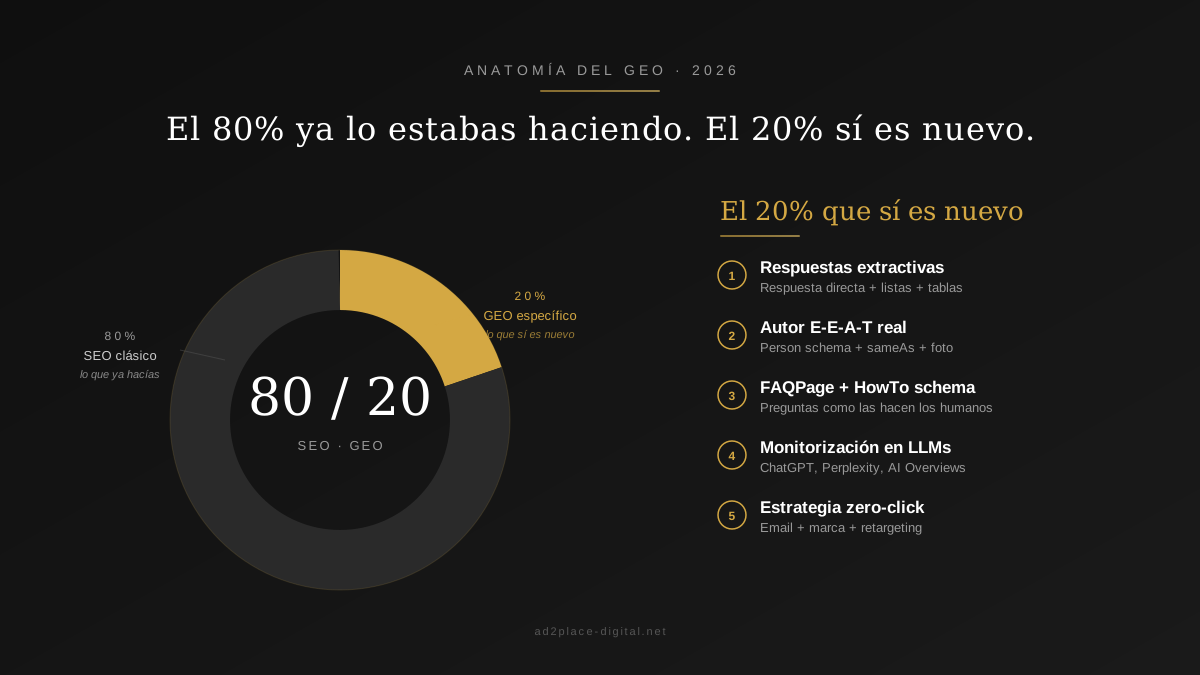
My position is clear: GEO is classic SEO at 80%. The other 20% does deserve attention and those are specific adjustments I’ll cover below. But the mental framework is the same. Anyone selling GEO as a completely new service or a separate specialist is selling hype.
The current GEO vs SEO narrative (and why you shouldn’t buy it)
This is the narrative floating around. Here’s a breakdown so you can spot it:
“Traditional SEO doesn’t work for LLMs.” False. LLMs feed on indexed sources. The sites they cite usually rank well in Google. A site without authority in traditional search won’t magically appear in ChatGPT.
“You need AI-specific content, different from human content.” Also false. Content that works in LLMs is clear, well-structured content with concrete data, cited sources and verifiable authors. Exactly what has been working in Google since the 2022 Helpful Content Update.
“Traditional search is dying.” Overblown. Google has lost some simple-query traffic to AI Overviews and chatbots. But it still drives, by orders of magnitude, more traffic than all LLMs combined. The pattern is redistribution, not extinction.
“You need to optimize for each LLM separately with different techniques.” Semi-false. What changes between LLMs is the interface, not the selection criteria. They all prioritize authoritative, structured content with clear trust signals. Optimize well for one, optimize for all.
“You need a GEO specialist.” False as a three-dollar bill. Any serious SEO who is current is already doing GEO without calling it that.
The 20% that actually is new and worth your attention
I’m not selling you that everything is hype. There are five real shifts you do need to incorporate. They’re not revolutionary, but they are new:
1. Structured content for extractive answers
LLMs and AI Overviews prefer extracting short, well-delimited snippets with concrete data. In practice:
- Every section starts with a direct 1-2 sentence answer before developing.
- Numbered lists and bullets for comparable data.
- Tables for pricing, versions, specs.
- Clear definitions at the start of each article (like “GEO is…”).
This is no different from well-executed on-page SEO. But the bar is higher. You used to get away with a long intro paragraph before getting to the point. Now that makes LLMs cite the competitor who gets straight to it.
2. Explicit E-E-A-T with a real, verifiable author
LLMs weight individual author authority heavily, not just domain authority. An article signed by a generic “Ad2Place Digital” has less chance of being cited than one signed by “José Redondo Delgado, SEO consultant in Barcelona, with a verifiable LinkedIn profile”.
Minimum requirements:
Personschema per author, withsameAspointing to LinkedIn, Twitter/X, professional profiles.- Visible bio on every article with real credentials (years, cases, certifications).
- Real photo. Not an illustration or avatar.
- Consistency between your identity on your site and on external profiles (same name, same photo, same role).
This has been working in SEO since 2022. With LLMs, it weighs even more.
3. Conversational schema and reinforced FAQPage
FAQPage schema with questions worded the way humans actually ask them (not rigid SEO phrases) is becoming the LLMs’ favorite format for citing specific answers. Same advice with HowTo for step-by-step tutorials.
Practical tip: every pillar article should include 6-10 FAQs covering the real questions your clients ask. Worded in first person, as if they were being asked. With 2-4 sentence answers.
4. Monitoring LLM mentions
Here there is a genuinely new tool category. Google Search Console tells you how you appear in Google, but not in ChatGPT, Perplexity or Gemini. For that, you need specific monitoring.
Reasonable options (2026):
- Peec AI or Profound — track brand and competitor mentions in LLMs.
- Otterly — focused on AI Overviews.
- Manual spot-checks — ask the LLM what your clients would ask and see who gets cited. Free but artisanal.
Not essential if you’re starting from zero. Essential once you have established traffic and want to defend positions.
5. Zero-click strategy: absorb the hit
AI Overviews answer many queries without requiring a click. Your impressions go up, your CTR goes down. This is a reality to accept.
How to absorb it well:
- Build an email list, don’t depend only on direct organic traffic.
- Recognizable brand so, even if they don’t click, they remember you and search you directly later.
- Retargeting for visitors who do come in.
- Content that generates mentions (the LLM cites you as a source even if the user doesn’t click).
Zero-click isn’t the end of SEO. It’s the end of SEO that depends on direct clicks. If your model was 100% based on unbranded organic traffic, yes, you have a problem. If you have brand and owned channels, GEO gives you additional visibility with fewer but better-qualified clicks.
GEO vs SEO in practice: your strategy with the 20% incorporated
This is the checklist I apply at Ad2Place in 2026. I’ve covered the 80% in depth in how to improve website ranking. Here I’ll only add the GEO-specific 20%:
- Audit the structure of every blog article: direct answer in the opening paragraphs, lists, tables, clear definitions.
- Reinforce author schema: Person with sameAs on every signed article.
- Audit FAQPage: are you using FAQPage schema? Are questions worded like humans ask?
- Add HowTo schema on step-by-step tutorials (operational articles).
- Monitor LLM mentions at least manually every 15 days (does your brand appear for relevant queries? Do competitors appear and you don’t? Why?).
- Data and cited sources in informational articles: linked stats, visible dates, explicit updates.
- Build or reinforce owned channels (email, newsletter) so you don’t depend on organic clicks alone.
Seven points. They fit in a morning of auditing your current site and 2-3 weeks of implementation on a small website. Without hiring anything new.
Metrics I’ll watch this year (and which I’ll ignore)
These are the ones that matter:
- Total impressions in GSC including AI Overviews. Still the main coverage indicator.
- Direct organic traffic (GA4). Won’t grow like it did five years ago. Expected growth: lower but more qualified.
- Brand mentions in LLMs (manual or via Peec/Profound). Proxy for your brand’s weight in AI.
- Organic conversions (GA4). The KPI that pays bills, as always.
- Direct branded searches. If they rise, AI is helping you (they see you, remember you, search you).
Which I’ll ignore:
- Isolated Google average position. Doesn’t say much anymore with AI Overviews redrawing the SERP.
- CTR per URL as a single indicator. Zero-click distorts it. Look at it alongside impressions, not alone.
- Keyword rankings in traditional trackers. They’re falling behind. Better monitor directly in GSC.
Why you won’t hire a “GEO specialist”
Let me be blunt: in 2026 any SEO agency not incorporating these five points from the 20% is obsolete, not that they aren’t “GEO specialists”. They just aren’t doing their job.
What’s happening with “GEO specialist” is what happened in 2015 with “mobile SEO expert” or in 2018 with “voice SEO consultant”. New name, same fundamentals, inflated price. If your current agency is doing serious SEO (periodic audits, intent-aligned content, topical authority, correct schema, E-E-A-T), they’re doing GEO without charging you extra.
If they’re not doing serious SEO, the problem isn’t that they don’t do GEO. The problem is they don’t do SEO.
What you can ask your agency right now
If you want to check your current SEO already covers GEO, ask your provider the following five questions. If they answer three or more poorly, consider switching:
- Do signed articles have
Personschema withsameAs? - Do articles carry 6-10 FAQs with
FAQPageschema? - Do you review GSC filtering for AI Overview appearances?
- Do you monitor (even manually) how your brand appears in ChatGPT and Perplexity?
- Is there a zero-click plan (email, brand, retargeting)?
That’s real GEO. Without the new label.
If you prefer self-service, an online SEO test gives you the technical state of your home in 60 seconds (Performance, SEO, Best Practices) — useful as a starting point. If you want us to take a look at your site together and tell you what you have covered and what’s missing from this specific 20%, book a free SEO consultation. In 30 minutes you leave with a clear checklist and zero hype.