This article is the first satellite of the GEO cluster I’m building. The pillar, GEO vs SEO: what changes in 2026, explains why GEO is classic SEO at 80%. Here I dive into one of the key 20% new points: how to appear in Google AI Overviews.
What AI Overviews are (and what they aren’t)
AI Overviews are synthetic responses that Google generates with its Gemini model and places at the top of the results page for many informational queries. They appear inside a distinct block, with cited sources on the right (desktop) or below (mobile).
People confuse AI Overviews with the old featured snippets. They aren’t the same. A featured snippet literally extracts a paragraph from a single page and shows it in position zero. An AI Overview synthesizes information from several pages and cites them as links. The distinction matters: in a featured snippet you own the winning URL. In an AI Overview you compete to be one of the 3-8 cited sources.
They aren’t SGE (Search Generative Experience) either. SGE was the 2023-2024 beta experiment. AI Overviews are its definitive evolution, integrated into Google.com and most markets since 2025.
And no, they aren’t “just another result”. On queries where they appear, they push the classic top 10 further down. Many people read only the AI answer and don’t scroll. Hence the industry’s obsession with being cited.
How Google decides which sources to include
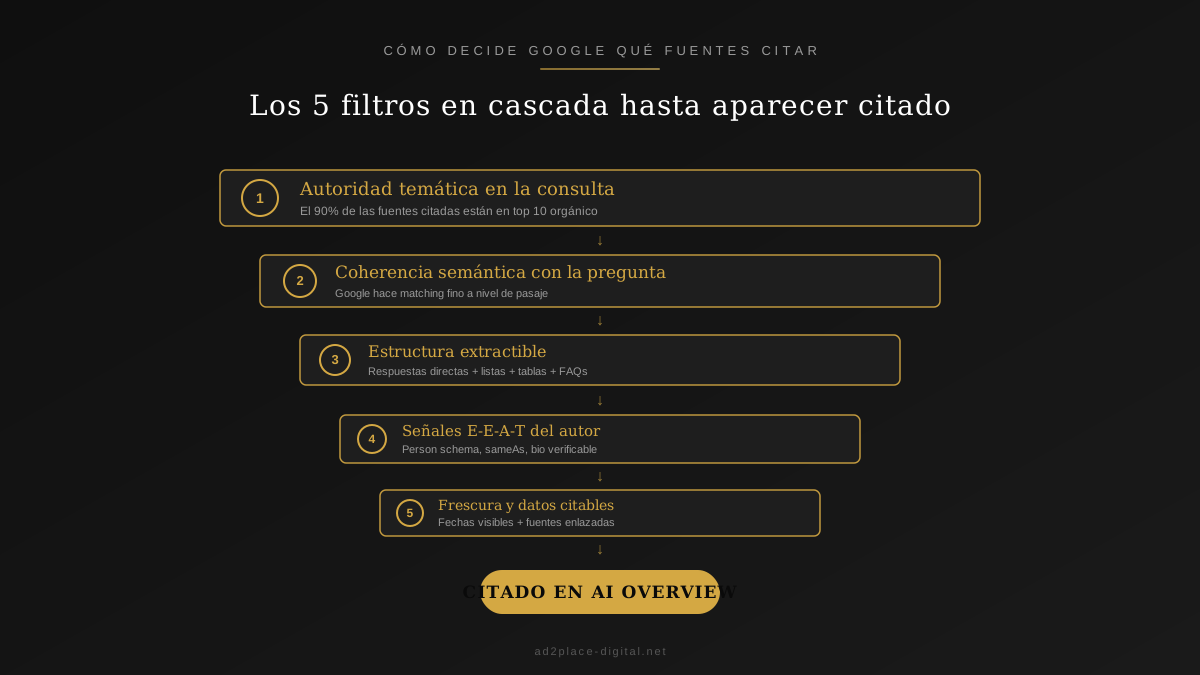
Google hasn’t published the exact formula, but between official statements, public patents and serious experiments we’ve seen, five criteria repeat:
Topical authority on the query. 90% of cited sources are top-10 for that same query in classic search. If you don’t rank well, you almost certainly don’t appear. First filter.
Semantic coherence with the question. The page must explicitly answer the question, not tangentially. An article on “what is SEO” that mentions AI Overviews in passing won’t be cited on AI Overview queries. Google matches at passage level.
Extractable structure. Short paragraphs, direct answers, lists, tables, clear definitions. Gemini prefers citing fragments extractable as-is without paraphrasing.
E-E-A-T signals. Author with verifiable profile, Person schema with sameAs, bio with credentials, dated cases. On YMYL queries (health, finance, legal) this filter tightens significantly.
Freshness and citable data. Data with visible dates, stats with linked sources, explicit updates. A 2021 guide on a fast-moving topic loses to a well-maintained 2025 one.
No magic, no secret algorithm. It’s SEO done well with a couple of added layers.
9-step checklist to appear in AI Overviews
This is the exact order I run with Ad2Place clients. Each step builds on the previous.
1. Pick queries where AI Overviews already appear
Don’t waste time optimizing for queries where Google doesn’t show AI Overviews. Spot-check: search your 20-30 business queries on Google and note which trigger an AI block and which don’t. Prioritize those that do.
General rule: they appear on “what is X”, “how to X”, “X vs Y”, “why X”, “best X for Y”. They rarely appear on “buy X”, “price X London”, “hire X”.
2. Check your current ranking for those queries
Open Search Console. Filter by query. Are you top-10 for that query? If not, work on classic ranking first — it’s a prerequisite. You won’t appear in an AI Overview for a query where you’re on page 4.
3. Rewrite the article opening to answer in 2 sentences
The first or second sentence of your article must answer the query’s question. Direct, no preamble. Writing “In this article we’ll see how to appear in AI Overviews…” loses the citation. Writing “To appear in Google AI Overviews you need to rank top-10 in classic search, structure content for extractive snippets and…” wins it.
4. Structure the body in extractable passages
Each H2/H3 section should start with a concrete 2-4 sentence answer before developing. Numbered lists for steps. Tables for comparisons. Clear definitions of technical terms. Gemini extracts what’s easy to isolate.
5. Add a FAQ section with FAQPage schema
6-10 questions worded the way humans actually ask them (“how long does X take?” not “X timeline”). 2-4 sentence answers, self-contained. FAQPage schema helps Google parse the questions. Often the FAQ is what ends up cited in the Overview.
6. Reinforce author E-E-A-T
In the article bio: real name, real photo, concrete credentials (years, cases, certifications), verifiable LinkedIn link. In the <head>: Person schema with sameAs pointing to LinkedIn, Twitter/X, professional profiles. An article without a clear author has 30-40% less chance of being cited on YMYL.
7. Cite sources with fresh data
Pages cited by Gemini often cite external authoritative sources themselves. It’s a meta trust signal. Add 3-5 outbound links to authoritative sources (studies, papers, bodies) when using data. Visible dates on stats.
8. Submit to indexing and wait 2-6 weeks
Google Search Console → URL Inspection → Request Indexing. Accelerates crawl. Then wait. Most-ignored step: people optimize, see no result in two weeks, conclude “it doesn’t work”. Patience measured in 4-8 weeks.
9. Monitor and refine
Weekly manual searches of your 10-20 target queries. If you appear, which fragment is cited? The FAQ? The opening? A table? Use that signal to reinforce that format elsewhere. If you don’t appear, who does? Read their pages and spot what they do differently.
Query types where you can appear (and where you can’t)
Not all queries show AI Overviews. Two months auditing 100 client queries give this pattern:
Appear frequently:
- “What is + concept” (pure informational)
- “How to X” (operational)
- “Difference between X and Y” (comparative)
- “Why + phenomenon” (explanatory)
- “Best + category + for + context” (educational recommendation)
Appear sometimes:
- Location queries (“lawyer Barcelona”) — niche-dependent
- “How much does X cost” — appears if there’s a lot of informational content, not if commercial landings dominate
- Opinion queries (“is X worth it”)
Almost never appear:
- Direct transactional queries (“buy X”, “hire X”)
- Navigational (“login”, “account access”)
- Brand searches (“Ad2Place”)
- Sensitive YMYL medical (Google stays conservative)
- Very local call-intent queries (“emergency dentist”)
If your business depends on queries from the third group, AI Overviews affect you less than you fear. If on the first, that’s where to focus.
How to measure if you’re appearing
Three practical approaches, cheapest to most expensive:
1. Regular manual search. Open an incognito window, search your 20 main queries and note whether an AI Overview appears and whether you’re cited. 20-30 minutes per week. Free.
2. Google Search Console. GSC includes AI Overview impressions in the total. It doesn’t tell you explicitly which ones, but if an informational URL gains impressions without proportional clicks, it usually means it’s cited in an Overview. Indirect but useful signal.
3. Specific tools. Peec AI, Profound, Otterly, Rankscale. 50-300 USD monthly. Automatically track your brand and competitors in AI Overviews and LLMs. Recommended once your cluster is established and you want to defend positions. Starting from zero, the three free options suffice.
What to do if you never appear (diagnosis)
If you’ve been optimizing for 2 months and never appear, the problem is usually one of these five. In order of probability:
You’re not top-10 for the query. Check GSC and confirm. If you’re position 15 or worse, the problem isn’t the Overview — it’s base ranking. That first.
Your page doesn’t answer directly. Read your article from the viewpoint of the user searching that exact query. Does the first sentence answer? Or do you start with historical context?
Missing extractable structure. Very long paragraphs, no H3, no lists, no FAQ. Gemini prefers scannable content. If your article reads like a thesis, it won’t cite you.
Anonymous or low-credibility author. No photo, no bio, no Person schema, no sameAs. On YMYL topics this is almost automatic disqualification.
Topic too sensitive or local. Some YMYL queries simply never show Overviews, or rotate aggressively between maximum-authority sources (gov, edu, major media). If your competition is gov/edu, aiming for the Overview is unrealistic — better to dominate top-3 organic.
Why this is a subset of SEO done right
Everything I’ve described are adjustments within the classic SEO frame. Content that answers intent, well-structured, with clear authority, by a real author, citing sources. No AI magic, no specific tricks. Anyone selling “AI Overviews Specialist certification” sells the same thing with a new label — I develop this in the GEO vs SEO pillar. If you also want to optimize for conversational LLMs, complement with SEO for ChatGPT and Perplexity.
If you have a healthy SEO project, appearing in AI Overviews is a natural increment. If your base SEO is broken, no “GEO” trick fixes it.
If you want a technical starting point before the call, an online SEO test on your home gives you the Performance, SEO and Best Practices diagnosis in 60 seconds — the base on which AI Overview eligibility is built. If you want us to review your site together and tell you which queries could appear in AI Overviews and what you’re missing to get there, book a free SEO consultation. In 30 minutes we leave with a concrete plan of what to change.