What “ranking a website” really means in 2026
How to improve website ranking no longer boils down to “write articles and buy links”. Ranking a website means getting it to appear on the first results page of Google for the queries that actually matter to your business. It sounds obvious, but most SMBs who reach my desk confuse traffic with ranking. Having 10,000 monthly visits from irrelevant keywords isn’t ranking. Having 500 monthly visits from people searching exactly what you sell is.
In 2026 the game shifted in three ways. First, direct clicks shrank because AI Overviews answer many queries without requiring a click. Second, Google weights real experience (the extra “E” in E-E-A-T) more than ever. Third, topic clusters with topical authority outperform generalist sites with more backlinks. If you’re still optimizing with the 2018 playbook, you’re losing ground every quarter.
I’ve spent more than ten years in SEO, and what drives real results for SMBs right now isn’t link building or technical tricks: it’s well-designed content architecture + sound technical foundation + patience measured in months. This guide on how to improve website ranking is the process I run with real Barcelona clients at Ad2Place.
The 3 pillars of modern ranking
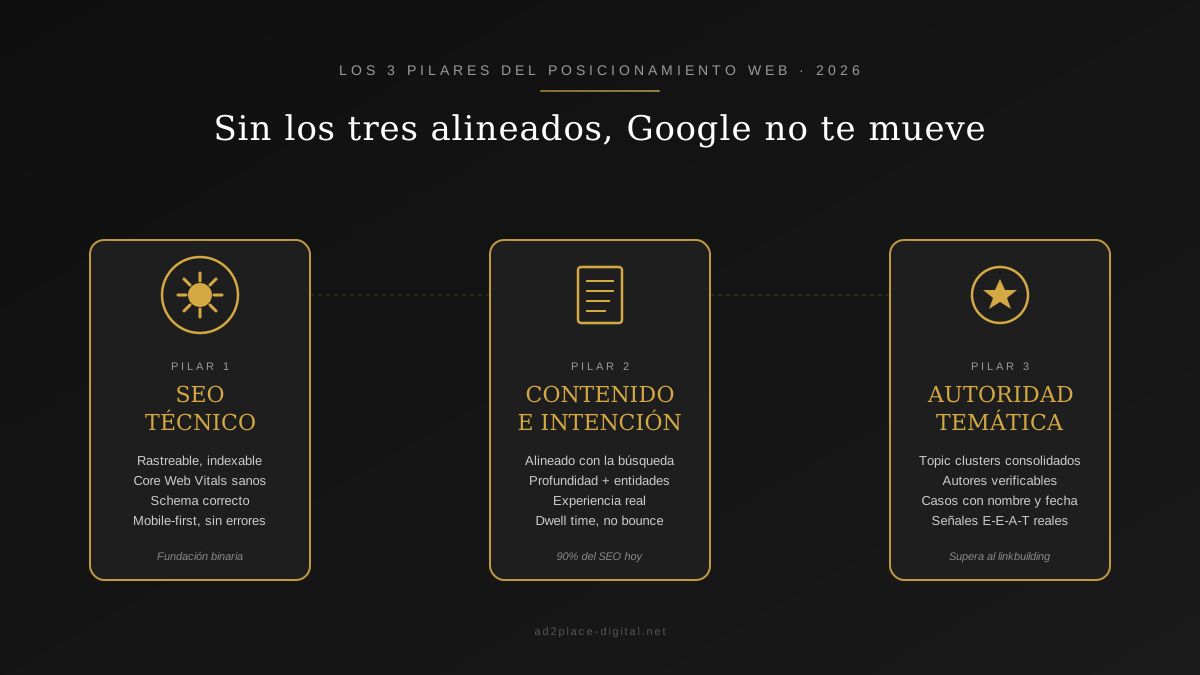
Everything that influences Google rankings falls into three pillars. If one fails, the other two can’t compensate. If all three align, ranking becomes a matter of time.
Pillar 1: Technical SEO
It’s the foundation. If Google can’t crawl, index and serve your site quickly, nothing else matters. Technical SEO answers binary questions: is it crawlable, indexable, fast, mobile-first, with correct schema, clean HTTP statuses, updated sitemap?
There are no nuances here. It either works or it doesn’t. A site with Core Web Vitals in red, massive 404 errors or misplaced noindex tags won’t rank no matter how great the content is. It’s the first place I look when a site underperforms.
Pillar 2: Content aligned with intent
90% of modern SEO is decided here. Content that covers full search intent, with depth, related entities and real expertise. It’s not about writing a lot: it’s about writing the right thing.
If someone searches “how to do an SEO audit”, they don’t want a definition of SEO. They want concrete steps, examples and tools. Many sites fail here because they write about what they know, not what the user is searching for. Google detects it in seconds (dwell time, bounce, pogo-sticking) and sinks you.
Pillar 3: Topical authority + E-E-A-T signals
What used to be “backlinks” is now topical authority and E-E-A-T. Referring domains still count, but they weigh less every year against: complete topic coverage, verifiable authors, dated case studies with real names, continuity over time, and domain coherence.
A cluster of 20 articles on a focused topic with a real author and Person schema outperforms, in most niches, a site with 100 purchased backlinks.
12-step checklist on how to improve website ranking
This is the order I follow with new Ad2Place projects. Don’t skip steps: each one supports the next.
1. Audit what you already have
Before optimizing anything, you need a clear snapshot. Use Google Search Console to see which pages receive actual impressions and clicks, which queries trigger your site and your average position. Cross with GA4 to find which traffic converts. Two to three hours is enough to prioritize.
If you don’t know where to start, the step-by-step guide is in how to do a complete SEO audit.
2. Define your hub topic and ICP
Before creating content, decide what topic you’ll demonstrate authority on and who your ideal customer is. Without this, everything else is improvisation. The hub topic must align with your main service, have enough search volume (>500 monthly on the head term) and allow 15-30 subtopics.
3. Fix the serious technical blockers
Check in this order: indexation (important pages blocked, misplaced noindex), speed (Core Web Vitals in red), mobile (broken layouts, high CLS), massive 4xx/5xx errors, redirect chains. These are show stoppers. Until they’re fixed, everything else delivers half its value.
If Core Web Vitals are your main pain, start with the complete Core Web Vitals guide.
4. Map the complete semantic universe
Build a map with every keyword, question and subtopic related to your hub. Use Search Console, Keyword Planner, AnswerThePublic, “People Also Ask” and the sites of your three best-ranking competitors. Classify each keyword by intent: informational, commercial, transactional, navigational.
5. Design your content architecture
Decide which pages you’ll create and how they’ll link to each other. Hub and spoke architecture works in 80% of cases: a central pillar + 5-30 satellites orbiting around it. Each satellite links to the pillar, the pillar links to the key satellites. Zero orphan pages.
The full strategy is in topical authority in SEO: how to build it.
6. On-page optimization without obsessing
For each page: one H1 with the main keyword, 50-60 char meta title with the keyword near the start, 140-160 char meta description with a hook, clean URLs with the keyword (/how-to-improve-website-ranking/, not /?p=1234), H2-H3 subtitles covering subintents, images with descriptive alt text.
Don’t stuff the keyword 50 times. Google uses semantic processing: mentioning it naturally 3-5 times plus LSI variations is plenty. Keyword density is a 2012 metric.
7. Write for intent, not for keywords
Before writing, ask: what exactly does someone searching this want? Definition? Steps? Comparison? Prices? Tools? Look at Google’s top 10 and detect the dominant pattern. If all 10 results are listicles, intent is list. If they’re step-by-step guides, it’s guide. Don’t fight the pattern: cover it better.
8. Implement relevant schema
Add JSON-LD schema for each page type: Article for blog, LocalBusiness for a company with a physical location, FAQPage for FAQs, BreadcrumbList for navigation, Person for authors. Schema doesn’t directly boost positions, but it earns you rich snippets (stars, expanded FAQs, breadcrumbs) that spike CTR.
9. Link internally with purpose
Internal links deliver 40% of the benefit of a topic cluster. Rules: each new page should receive at least 3 inbound links from related pages, anchor text must describe the destination (not “click here”), the pillar must link to key satellites from its own structure, and no important page can be orphaned.
10. Accelerate indexation
For new pages: submit the updated sitemap, request indexation in Search Console (URL Inspection → Request Indexing), and link from an already-crawled page (home, main blog). Google usually indexes in 1-7 days if the site has a clean history. Without this, it can take weeks.
11. Monitor and correct in 30-day cycles
Don’t touch the project daily. Review it every 30 days with this ritual:
- Aggregated cluster impressions (Search Console) — trending up?
- Average position per URL — what’s dropping, what’s rising?
- New queries appearing — content gaps to fill?
- CTR per URL — pages with good position but poor CTR? (title rewrite opportunity)
- New technical errors in GSC
Two hours per month on this exercise lets you make data-driven decisions, not gut-driven ones.
12. Update existing content on a cadence
Articles aren’t written and forgotten. Every 6-12 months, update the most important ones: change the visible date, refresh examples, add sections if new queries emerge, optimize titles if CTR is low. Google rewards well-maintained “fresh” content more than mediocre new content.
Realistic timeframes: how long until you see results
This is the most asked question, and the answer almost always surprises.
Weeks 1-6: No visible ranking results. What’s actually happening is Google is crawling, indexing and evaluating the new signal. What moves are technical metrics: Core Web Vitals, index coverage, errors cleared.
Months 2-4: Long-tail positions (most specific queries, 4+ words) start moving. Head terms stay still. Many projects get abandoned here believing “it doesn’t work”. A mistake: long tails are the prelude to bigger movement.
Months 4-8: With consistent work, medium-competition keywords (2-3 words) start moving. Aggregated cluster impressions may have doubled or tripled. Organic traffic grows.
Months 8-18: Competitive head terms start moving. High-value transactional keywords are won in this window. This is where real ROI shows.
Anyone promising top 3 in 6 weeks is lying or about to burn your domain with grey-hat tactics. Serious SEO is a marathon: the first kilometers look like they lead nowhere.
Mistakes that kill website ranking
I’ve seen these five repeat over and over in SMB audits.
Uncontrolled cannibalization. Three different articles targeting the same keyword. Google can’t decide which to rank and ends up ranking all three poorly. Rule: one main keyword per URL. If you have duplicates, consolidate with 301 or expand to differentiate intent.
Bulk thin content. Publishing 40 articles of 500 words thinking it “fills the site” generates the opposite: Google detects the pattern and applies a quality penalty to the whole domain. Ten deep 2,000-word articles beat forty shallow ones.
Ignoring technical SEO. Perfect content on a site with 5-second LCP won’t rank. Before investing in content, make sure the technical foundation is sound.
Zero internal linking. Orphan pages, generic anchor text (“click here”), pillar with no links from satellites. A cluster without internal links is a library without an index.
Copying competitors verbatim. Doing the same as #1 puts you at #11 at best. You must cover what they cover and add something differential: your own experience, your own data, an angle no one else has. Without differentiation you overtake no one.
Metrics I check monthly
Only five. All the decisions come from these.
Aggregated cluster impressions. Sum of impressions across all URLs in the hub + satellites. Monthly trend. If it rises, you’re gaining coverage and Google is showing you for more queries.
Weighted average position. Average of core page positions, weighted by volume. 6-9 month trend: should decrease (better positions).
Top-10 CTR per URL. Pages with good position but CTR below position benchmark (e.g. position 3 with 3% CTR when it should be 10%) are direct title rewrite opportunities.
Organic conversions in GA4. The only KPI that pays bills. Traffic without conversions is worthless.
Share of voice. In how many of my cluster’s SERPs do I appear vs. direct competitors. Quarterly, not monthly.
If you want to understand how to configure GA4 to measure this properly, the guide is here.
Tools I use day-to-day
This is how any Ad2Place project starts. 80% of the work can be done with free tools alone.
- Google Search Console (free) — mandatory, no alternative.
- GA4 (free) — conversions and behavior.
- PageSpeed Insights / Lighthouse (free) — Core Web Vitals and technical audit.
- Screaming Frog (free up to 500 URLs) — technical crawl.
- Ahrefs / Semrush (paid) — competition and keyword analysis at scale. Not mandatory.
- Claude / AI — assistance for briefs and content review, not for writing the article for you.
Why this strategy works without link building
At Ad2Place we don’t sell link building. We have clients in the top 3 on Google for competitive Barcelona keywords applying exactly this process. The reason: in 2026 Google disproportionately rewards the combination of sound technical foundation + deep topical coverage + real E-E-A-T signals + continuity.
Link building still matters in hyper-aggressive YMYL (finance, gambling, pharma) or when you’ve maxed out the content ceiling. For 80% of SMBs, investing the same budget in a quality cluster yields far more per euro.
If you want us to review your site together and tell you which cluster to build first, in which order and how long it will take, book a free SEO consultation. In 30 minutes you leave with a clear plan.