
This is the third satellite of the GEO cluster I’m building. The pillar, GEO vs SEO: what changes in 2026, defends that GEO is classic SEO at 80%. The two previous satellites break down how to appear in Google AI Overviews and SEO for ChatGPT and Perplexity. Here I land the signal that most separates who LLMs cite from who they ignore: E-E-A-T.
What E-E-A-T is and why LLMs look at it even harder than classic Google
E-E-A-T are four initials Google coined in 2022 for its Quality Raters: Experience, Expertise, Authoritativeness, Trustworthiness. First-hand experience, demonstrable deep knowledge, external reputation, overall trustworthiness. Combined they determine whether content deserves to appear in top results.
In classic Google, E-E-A-T is one signal among many, weighed alongside backlinks, semantic relevance and technical health. In generative LLMs (ChatGPT, Perplexity, Gemini, Claude) the weight is disproportionate. When a model has to pick 3-8 sources to cite in an answer, it can’t afford to cite someone who looks dubious: if it cites poorly, the answer generates misinformation and the whole product loses credibility. The result: LLMs filter by Trust first, then look at relevance.
I tested this with Ad2Place clients: two sites in the same sector, same domain authority, nearly identical content. The one signing with real author + complete Person schema + verifiable LinkedIn appeared 4× more often in Perplexity answers for niche queries. The one signing “Editorial team” didn’t appear once.
The 4 pillars of E-E-A-T explained plainly
Experience (the newest “E”, added in 2022)
First-hand contact with what you describe. An article about Barcelona restaurants written by someone who has eaten at those restaurants weighs more than the same article written by someone who only knows them through the web.
How to demonstrate it: own photos, named cases (anonymized if needed), specific dates, specific numbers from your own projects, first-person anecdotes, testimonials on your site.
Typical mistake: writing as if you just skimmed the topic. LLMs detect the impersonal tone and downgrade.
Expertise (deep knowledge)
Technical mastery of the topic. Correct terminology, nuances only known by someone who has worked years in the field, references to primary sources, historical context.
How to demonstrate it: author bio with verifiable credentials, years of experience, certifications, previous publications, depth in articles (explain mechanisms, not just surfaces).
Typical mistake: copying terminology without understanding it. LLMs are sensitive to technical inconsistencies and penalize sources that have them.
Authoritativeness (external reputation)
What others say about you. Media mentions, citations from other sites in the sector, collaborations with recognized organizations, talks, podcasts, awards.
How to demonstrate it: “Featured in” page with real links, testimonials with real name and company, Person schema with sameAs pointing to consolidated external profiles.
Typical mistake: inflating authority with empty badges (“as seen in…”) without real links. LLMs verify the link: if it doesn’t exist, penalty.
Trustworthiness (reliability) — the heaviest one
Everything that makes a reasonable user trust your site. HTTPS, visible privacy policy, real contact info (not just a form), cited external sources, visible publication and update dates, absence of unsupported claims.
How to demonstrate it: HTTPS, complete legal pages, physical address if you’re a company, phone, real email, well-populated Organization schema, links to external sources with direct URLs.
Typical mistake: “Contact” page with only a generic form, no address, no phone. LLMs read that as opacity.
How each LLM evaluates E-E-A-T (comparison matrix)
I’ve spent months testing and cross-referencing data with tools like Peec AI. The pattern is clear:
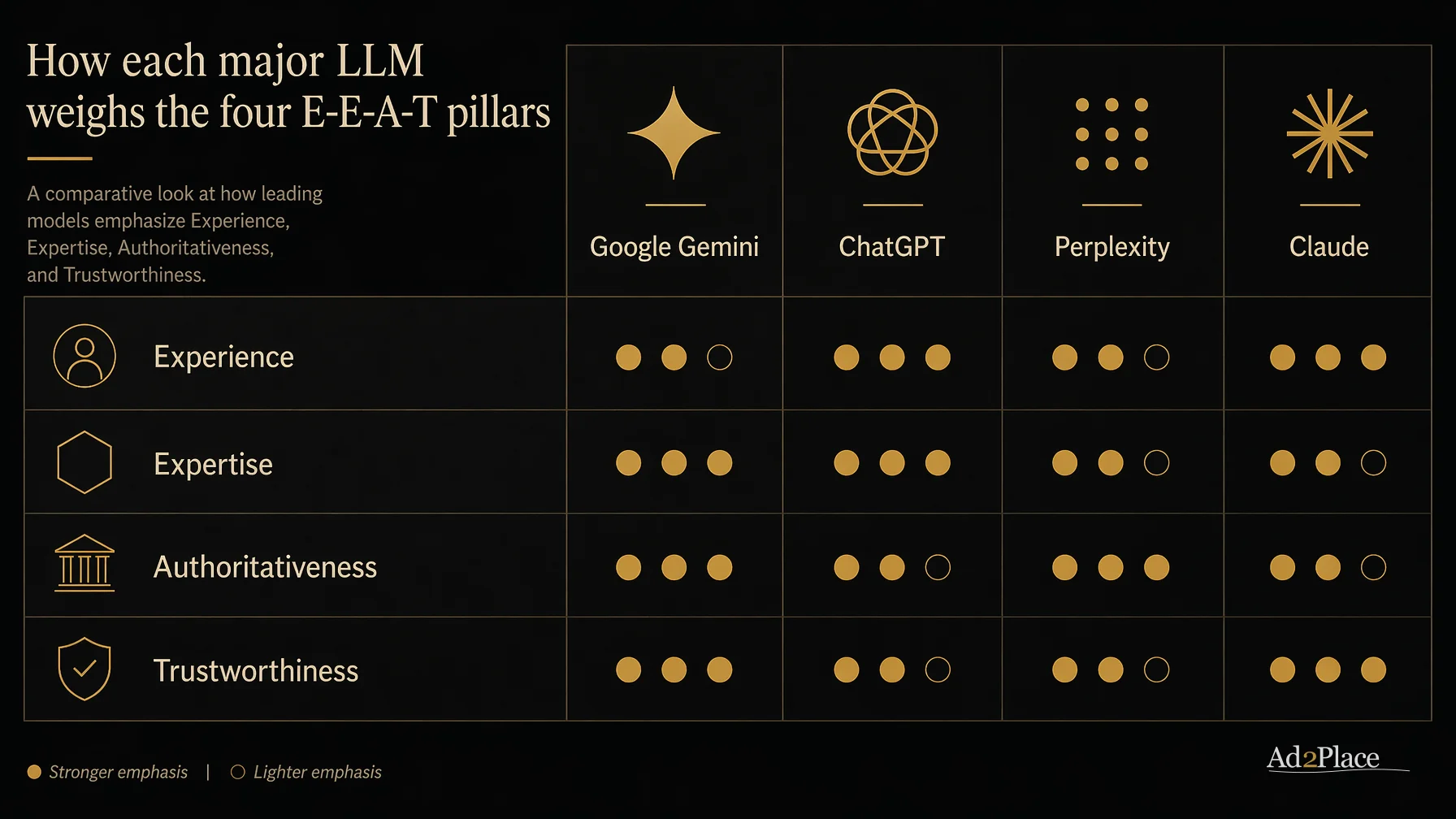
- Google (AI Overviews, Gemini): Trust first, then Authoritativeness via backlinks. In YMYL, Trust spikes to become almost the only filter.
- ChatGPT (SearchGPT + Bing): Trust and Expertise on par. Heavily values Person schema and internal domain coherence (clear niche).
- Perplexity: weighs Experience highest (concrete cases, own data). It’s the one that most easily cites independent authors if they show real practice.
- Claude: leans on Authoritativeness (academic reputation, recognized media) when using web search. Less permeable to emerging authors unless external proof exists.
Operational implication: if you can only invest in one pillar, work Trustworthiness. It covers the filter across all 4 LLMs.
8 concrete signals LLMs read
This is what I apply on every client site. In this order.
1. Complete Person schema on every signed article
Putting the author name in text isn’t enough. You need to declare Person schema in JSON-LD with: name, url (internal profile on your site), jobTitle, image (real photo), sameAs (array with LinkedIn + at least one more professional profile), worksFor (the organization), and optionally alumniOf and knowsAbout. LLMs parse this schema and use it as a trust marker.
2. Dedicated, complete author page
Every signing author should have their page: /author/name-surname/. With real bio (150-300 words), verifiable credentials, list of published articles, links to external profiles, professional photo. This page is what LLMs consult when deepening Trust checks.
3. Visible bio at start or end of each article
Not only on a separate page. On every article: name + photo + 1-2 lines of credentials + link to the author page. Closes the loop for users and LLM scrapers.
4. Visible publication and update dates
Publication date always. Update date when refreshed. In the MDX frontmatter AND in the visible text (not only in schema). LLMs prefer sources with demonstrable freshness.
5. Real cases with names, dates and metrics
Every strong claim should be backed by a proprietary case, a linked external study, or a verifiable figure. “Long articles rank better” isn’t valid; “in 6 Ad2Place clients with 3,000+ word articles, GSC impressions rose on average by 180% over 8 months” is valid.
6. External links to authoritative sources
3-5 outbound links per long article. To studies, official documentation, recognized authority sites. Citing sources is the most underrated Trust marker. Sites that cite get cited.
7. Organization schema with complete data
The whole site should declare the organization: name, url, logo, address (real postalAddress), telephone, email, sameAs (corporate social profiles), foundingDate. For physical businesses, add LocalBusiness with geo and opening hours.
8. HTTPS, privacy policy, legal notice, cookies
Technical baseline. Without these, no LLM cites you on sensitive topics. With these, you pass the initial Trust filter and can fight for the other 3 pillars.
What automatically disables your E-E-A-T
Five mistakes I’ve seen sink entire sites. If you have any of these, regenerate content before working on new signals.
- Anonymous or generic author (“Editorial”, “Admin”, “Team”). LLMs detect it and filter.
- Stock photos as “author photo”. Google Lens identifies stock. LLMs inherit that filter. Use a real photo or none.
- Bios with unlinked claims (“20+ years of experience” without LinkedIn or publications). Penalized as unverifiable claim.
- Referencing other sites in the same network without disclosing the relationship. LLMs detect PBN and downgrade.
- YMYL without credentials. Writing about health, finance or legal without showing professional training or experience is automatic disqualification in these niches.
E-E-A-T in YMYL: why it’s decisive
YMYL (“Your Money or Your Life”) are topics where bad information can cause harm: health, finance, legal, critical engineering, nutrition, therapies. In YMYL, E-E-A-T stops being one signal and becomes the dominant factor.
An article on “how to invest $10,000” written by someone without visible financial credentials doesn’t appear in LLMs or Google. Doesn’t matter the domain authority. A similar article signed by someone with verifiable credentials (CFA, industry experience, previously published in recognized outlets) does appear.
Practical rule: if your niche grazes YMYL, over-invest in Experience + author credentials. If you don’t graze YMYL, with Trust and Expertise well covered you’re set.
6-step plan to strengthen your E-E-A-T today
Order that works on projects we audit at Ad2Place.
Step 1 — Audit what you have
List every published article and check: does it have visible author? date? does it cite sources? is Person schema in the HTML? Spreadsheet. Identify gaps.
Step 2 — Create/reinforce the main author page
Start with one person (probably you or the founder). Complete page, schema, sameAs. One good page beats ten bad ones.
Step 3 — Implement Person schema on every signed article
Frontmatter in the CMS + JSON-LD rendering. If you use Astro (like the Ad2Place site), it’s done in 15 minutes for the whole site.
Step 4 — Refresh the 10 highest-impressions articles in GSC
Add author bio, visible update date, 3 new external links to authoritative sources, real case or proprietary data. Refreshing what already ranks is more profitable than creating new content.
Step 5 — Complete Organization schema on the site root
A single JSON-LD in <head> with all corporate data. If you’re LocalBusiness, add that too. Once done well, not touched again.
Step 6 — Continuous Authoritativeness strategy
Appearing in media, collaborating on podcasts, citing and being cited. Built over months, not a sprint. But without this, visible ceiling in LLMs with tighter Authoritativeness filter (Claude, Gemini in YMYL).
How to measure if you’re gaining E-E-A-T
Four practical metrics:
- Average position in GSC for YMYL niche queries. Rises when Google recognizes your E-E-A-T.
- LLM mentions (Peec AI, Profound, Otterly). When you appear in more answers for more queries, your E-E-A-T is consolidating.
- Direct brand/name searches. Organic growth in searches with your name is hard proof of real authority.
- Referral from LinkedIn/X to your author page. If external profiles drive traffic to your
/author/, the loop is working.
Why you won’t solve this by hiring an “AI SEO expert”
Everything described here is SEO done well applied with discipline. Agencies selling “AI SEO” as a differentiated service usually charge double for the same thing. If your current SEO contemplates real author with schema, cases with data, external sources cited and editorial continuity, you’re already doing 90% of your E-E-A-T for LLMs. I develop this thesis in the GEO vs SEO pillar.
Before the call it helps to have a starting point: run an online SEO test on your home page and bring the technical report so the call is more useful. If you want us to review your site together and tell you which 3-4 E-E-A-T levers would give the highest return in your specific case, book a free SEO consultation. In 30 minutes we leave with a clear plan.