Why 70% of Small Businesses Fail at Digital Marketing (and How to Avoid It)
This is not a made-up statistic. According to a CB Insights study updated in 2025, 70% of small businesses that invest in digital marketing do not recoup their investment within the first 12 months. Not because digital marketing does not work — it works extraordinarily well — but because most small businesses make the same avoidable mistakes.
The three most common:
-
They start with the tool, not the strategy. They set up Google Ads without a website that converts. They post on Instagram without knowing what they want to achieve. They invest in SEO without researching what their customers actually search for.
-
They spread the budget across too many channels. A small business with 500 EUR per month that splits it between SEO, Ads, social media, email marketing, and content produces zero results in any of them. Focus is the key.
-
They do not measure, or they measure wrong. Without web analytics properly configured, they have no idea what works and what does not. They make decisions based on gut feeling instead of data.
This guide exists so your business does not become part of that 70%. We are going to build a realistic digital marketing strategy, with real budgets and an executable action plan for the first 90 days.
The 5 Pillars of Digital Marketing for Small Business
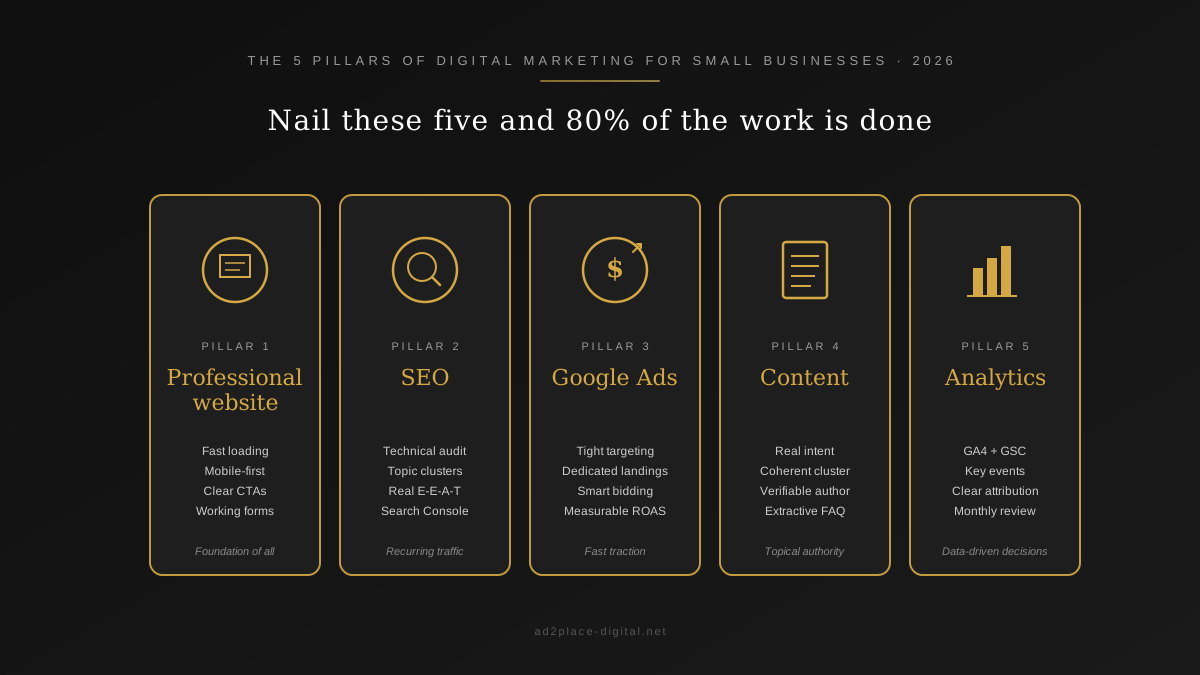
You do not need to master 20 disciplines. Digital marketing for a small business rests on 5 pillars. Get these five right and 80% of the work is done.
1. A Professional Website That Converts
Your website is not a digital business card. It is your salesperson working 24 hours a day, 7 days a week. And like any salesperson, it has to do one thing well: turn visitors into contacts.
What a small business website needs to convert:
- Load speed under 2.5 seconds — If it takes longer, 53% of visitors leave before seeing anything (Google data, 2024).
- Perfect responsive design on mobile — In Europe, over 65% of web traffic is mobile. If your site does not work properly on a small smartphone screen, you lose the majority of your visitors.
- Clear CTA on every page — A contact button, a form, a phone number. The visitor must know exactly what to do within the first 5 seconds.
- Social proof — Real testimonials, client logos, case studies. People trust the experience of others.
- Basic technical SEO — Schema markup, optimized meta tags, Core Web Vitals in the green.
Not sure if your website meets these criteria? Check our guide on how much a professional website costs to understand what level you need and what budget it implies. If you need a new site, our web design service covers everything above.
2. SEO: Let Google Find You for Free
SEO (Search Engine Optimization) is the discipline that gets your website to appear in Google results when someone searches for what you sell. No paid advertising. Free.
For a small business, SEO has one enormous advantage over advertising: the traffic you earn today keeps coming tomorrow, next week, and next month. A well-ranked article can generate customers for years without you spending another cent.
The SEO essentials for small businesses:
- Keyword research — Know what your audience searches for. Not what you think they search for, but what they actually type into Google.
- Local SEO — For businesses with a physical location, Google Business Profile is non-negotiable. The “local pack” (the map with 3 results) generates over 40% of clicks on local searches.
- Quality content — Google rewards useful, original content created by people with real experience (E-E-A-T). Generic AI-generated text without human review ranks worse with every update.
- Technical SEO — Speed, indexation, URL structure, internal links. If your site has technical errors, it does not matter how good your content is.
SEO is not magic and it will not produce results in a week. But a 6-month investment in professional SEO can build an organic traffic stream that permanently reduces your dependence on paid advertising.
3. Google Ads: Immediate Results with Control
While SEO builds foundations over the medium term, Google Ads puts you in front of potential customers from day one. It is the perfect tool for:
- Launches — You have a new service and need to validate demand quickly.
- Seasonality — Your business has peaks at certain times and you need to capture that temporary demand.
- Highly competitive keywords — If ranking organically for “lawyer London” takes 12 months, Google Ads gets you there tomorrow.
- Complement to SEO — Companies that combine SEO + Ads have a combined CTR 25% higher than those using only one channel.
What you need to know about Google Ads budgets:
- Minimum viable: 300-500 EUR per month in sectors with low CPC (under 2 EUR)
- Recommended: 1,000-2,500 EUR per month for Search + Performance Max campaigns
- To scale: 3,000+ EUR per month with multi-campaign strategy
For detailed figures by industry, our guide on how much Google Ads costs in 2026 breaks down all the ranges with real market data. You can also use our Google Ads calculator to estimate your investment based on your sector and location.
The key to Google Ads is not spending more but spending smarter. A high Quality Score can cut your CPC in half. An optimized landing page can double your conversion rate without touching the budget. Our Google Ads management team focuses on exactly that.
4. Content That Attracts Qualified Customers
Content marketing is not “having a blog.” It is creating strategic content that answers the questions your potential customers ask Google before they buy.
A concrete example: if you run a renovation company in Barcelona, your potential customers search for “how much does it cost to renovate a flat in Barcelona,” “renovation permits needed,” “best bathroom materials.” If you publish articles that answer those questions with real data and demonstrable expertise, Google ranks you, the user arrives at your site, sees you know what you are talking about, and contacts you.
Types of content that work for small businesses:
- Blog articles with real data and experience (not filler)
- Practical guides that solve specific problems
- Case studies that demonstrate results
- Comparisons (product A vs product B)
- FAQs optimized for featured snippets
- Calculators and tools that provide immediate value
The minimum effective frequency for a small business blog is 2 articles per month of 2,000+ words. Less than that and Google does not see enough activity to consider you an authority source on your topic.
5. Analytics: Measure to Improve
If you do not measure, you do not improve. And if you measure wrong, you get worse. Analytics is the pillar that supports all the others, because it tells you what works, what does not, and where to put your money.
The minimum a small business needs to have configured:
- Google Analytics 4 — To measure traffic, behavior, and conversions. Our complete GA4 tutorial walks you through the setup step by step.
- Google Search Console — To see which keywords you appear for, your average position, and crawl errors.
- Configured conversions — Forms, calls, emails. If you do not measure how many leads your website generates, you do not know if your marketing works.
- UTM parameters on every campaign — To know exactly where each visit and each lead comes from.
The 5 metrics every small business should review weekly:
- Cost per lead (CPL) — How much does it cost to acquire a qualified contact?
- Website conversion rate — What percentage of visitors contact you?
- Organic traffic — How many visits come from Google without paying?
- ROAS — For every euro invested in advertising, how many euros do you invoice?
- Lead source — Where do your best customers come from? (SEO, Ads, social, referrals)
How Much Should a Small Business Invest in Digital Marketing
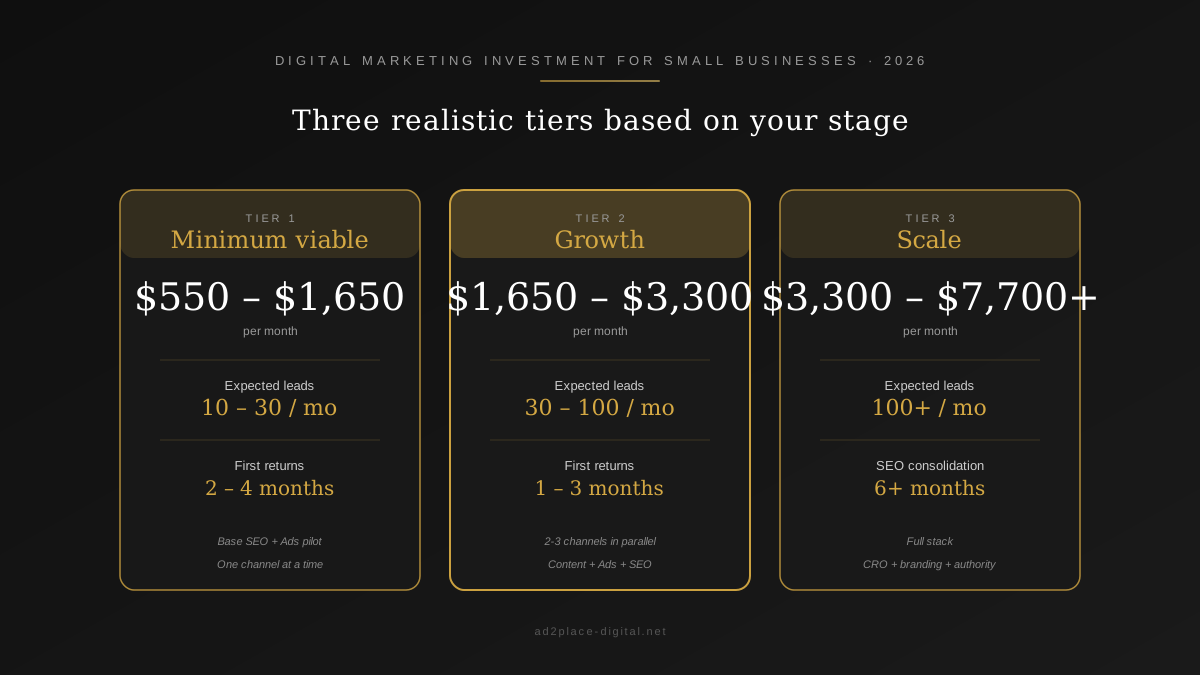
The million-dollar question. The honest answer: it depends. But here are the three real investment ranges in the European market in 2026, with figures you can use for budgeting.
Minimum Viable Investment
300 – 500 EUR per month
For a small business starting from zero that needs to validate whether digital marketing works in their sector.
- Basic SEO (optimized Google Business Profile + 1 article per month)
- Or a modest local Google Ads campaign
- An existing website that works reasonably well
What you can expect: 5 to 15 leads per month in low-competition local sectors. Enough to validate demand but not to grow.
Recommended Investment for Growth
1,000 – 2,500 EUR per month
The range where digital marketing begins to generate real, sustained returns.
- Professional SEO with content strategy (4-6 articles per month)
- Google Ads with sufficient budget for the algorithm to optimize
- Professional website with CRO (conversion rate optimization)
- Advanced analytics with monthly dashboards
What you can expect: 20 to 80 leads per month depending on sector. Visible organic growth from month 3-4. Progressive reduction in cost per lead.
Investment to Scale Aggressively
3,000 – 7,000+ EUR per month
For small businesses already generating solid revenue that want to dominate their sector online.
- Advanced SEO with topic clusters and topical authority
- Multi-campaign Google Ads (Search + Performance Max + Remarketing)
- Professional content production
- Managed social media with conversion strategy
- Integrated CRM with automations
What you can expect: 100+ leads per month. Top 3 rankings for main keywords in 6-12 months. Recognized online brand in your sector.
| Investment Level | Monthly Budget | Expected Leads | Time to Results |
|---|---|---|---|
| Minimum viable | 300 – 500 EUR | 5 – 15 | 1 – 3 months |
| Growth | 1,000 – 2,500 EUR | 20 – 80 | 3 – 6 months |
| Scale | 3,000 – 7,000+ EUR | 100+ | 1 – 3 months (Ads) + 6 months (SEO) |
The 7 Most Common Digital Marketing Mistakes Small Businesses Make
After working with dozens of small businesses, these are the mistakes I see again and again:
1. Investing in Google Ads without a website that converts. Sending paid traffic to a slow site with no clear CTA and no social proof is burning money. Optimize the website first, then invest in traffic.
2. Trying to be on every social media platform. A small business with limited resources that tries to maintain an active presence on Instagram, LinkedIn, TikTok, Facebook, X, and YouTube ends up doing everything poorly. Choose 1-2 platforms and dominate them.
3. Not having an optimized Google Business Profile. For local businesses, Google Business Profile is more important than the website itself. 46% of Google searches have local intent. If your profile is not optimized with professional photos, reviews, hours, and posts, you are losing a massive source of customers.
4. Creating content without keyword research. Writing about what you find interesting instead of what your customers actually search for is the most expensive content mistake. Before writing a single article, research search volume and intent.
5. Not tracking conversions. 60% of small business websites do not have conversions configured in Google Analytics. They literally do not know how many leads their website generates. Invest 2 hours in configuring conversions before spending a single euro on advertising.
6. Expecting SEO results in one month. SEO works, but it needs time. Small businesses that hire SEO for 3 months, do not see miracles, and cancel are wasting their investment just before it was about to bear fruit. The minimum realistic commitment is 6 months.
7. Copying the competitor’s strategy without understanding context. Just because your competitor invests 5,000 EUR per month on Instagram does not mean you should do the same. Maybe their audience is there. Maybe yours is not. Strategy is built from your business data, not from imitation.
How to Get Started: 90-Day Action Plan
Stop planning in the abstract. Here is a concrete plan, week by week, to launch digital marketing for your small business in 90 days.
Month 1: The Foundations
Week 1-2: Research and Strategy
- Define your ideal customer (sector, size, problem you solve, budget)
- Research 50-100 keywords your audience searches on Google (use Ubersuggest or Google Ads Keyword Planner)
- Analyze the top 5 competitor websites (what they do well, what they do poorly)
- Decide your 2-3 main channels (SEO + Ads is the most effective combination for most businesses)
Week 3-4: Digital Infrastructure
- If you do not have a professional website, get one built. If you do, run a quick audit of speed (PageSpeed Insights) and mobile usability
- Configure Google Analytics 4 properly (follow our GA4 tutorial)
- Create or optimize Google Business Profile with professional photos, keyword-rich description, and correct categories
- Set up Google Search Console and submit your sitemap
- Install a basic CRM (free HubSpot or Pipedrive trial) to ensure no lead gets lost
Month 2: Traction
Week 5-6: Content and SEO
- Publish 2 articles optimized for keywords with real search volume
- Optimize the 5 most important pages on your website (title, meta description, H1, content)
- Build your internal linking strategy (every important page should have at least 3 internal links pointing to it)
- Request reviews from your 10 best clients on Google Business Profile
Week 7-8: Advertising
- Launch a Google Ads Search campaign targeting the 10-15 most transactional keywords
- Create specific landing pages for each keyword group (do not send all traffic to the homepage)
- Configure conversion tracking in Google Ads imported from GA4
- Set a realistic daily budget and let it run for 2 weeks before making adjustments
Month 3: Optimization
Week 9-10: Analysis and Adjustment
- Review GA4 data: how many leads? Where do they come from? Which pages convert?
- Adjust Google Ads campaigns: pause keywords that do not convert, increase bids on those that do
- Publish 2 more articles and measure their performance in Search Console
- Optimize your website conversion rate: test a different CTA, simplify the form, add testimonials
Week 11-12: Scale What Works
- Identify your 3 most profitable lead sources and double the investment in them
- Eliminate what does not work (any channel that has not generated leads in 90 days probably will not)
- Plan the next 3 months with numerical targets (X leads per month, Y cost per lead, Z organic traffic)
- Automate where possible: automated weekly reports, automated lead responses, email nurturing
How We Work with Small Businesses at Ad2Place
At Ad2Place we have spent over a decade helping small and medium-sized businesses generate customers through digital marketing. Our approach is different from most agencies and is designed specifically for SMBs: If your business fits a specific sector, the detail is in digital marketing by industry.
No lock-in contracts. We do not tie you into 12-month agreements. If after 3 months you do not see value, you leave. That forces us to demonstrate real results every single month, not coast on a signed contract.
Strategy first, tools second. Before touching Google Ads or publishing an article, we research your market, your competition, and your customers. Strategy defines tactics, never the other way around.
Real data, not vanity metrics. We do not tell you “you had 10,000 impressions on Instagram.” We tell you “you generated 47 qualified leads this month, 12 converted into customers, and they invoiced X EUR.”
A senior point of contact. At Ad2Place your strategy is led by José Redondo Delgado, with over 10 years of experience in SEO and digital marketing. You do not get passed through a salesperson, an account manager, and an intern. You speak directly with the person making decisions on your project.
Written fixed-price quotes. Before we start, you know exactly how much you will invest, what it includes, and what results to expect. No surprises, no “extras” halfway through the month.
If you are a small business that wants to start (or improve) digital marketing with a realistic, measurable strategy, book a free SEO consultation of 30 minutes. We analyze your current situation, identify the highest-impact opportunities, and deliver a concrete action plan — no commitment.
You can also use our Google Ads calculator to estimate how much you would need to invest in advertising based on your sector and goals.
Frequently Asked Questions
How much should a small business spend on digital marketing per month?
The minimum viable investment is 300-500 EUR per month. For sustainable growth, the recommended range is 1,000-2,500 EUR. The general rule is to allocate between 7% and 12% of revenue to marketing.
How long does digital marketing take to produce results for a small business?
Google Ads can generate leads from the first week. SEO needs 3 to 6 months for significant traction. The most effective approach is using Ads for immediate results while SEO builds organic traffic in parallel.
Does a small business need to be on every social media platform?
No. Choose 1-2 networks where your audience is and work them well. For B2B, LinkedIn. For local consumer businesses, Instagram and Google Business Profile. Consistency matters more than platform count.
SEO or Google Ads: which is better for a small business?
It is not about choosing one. Start with Google Ads for immediate results while investing in SEO. Gradually reduce ad spend as organic traffic grows. This progressively reduces your dependence on paid advertising.
Can a small business handle digital marketing without an agency?
Yes, but with limitations. Technical SEO, advanced Google Ads, and analytics require specialized knowledge. Most small businesses that try to do everything in-house end up spending more than if they had hired professional help.
What are the key metrics a small business should track?
The 5 fundamentals: cost per lead, website conversion rate, monthly organic traffic, ROAS on paid campaigns, and customer lifetime value (LTV). If you are not tracking these 5, you are investing blind.
Next Step: Launch Your Digital Marketing
If you have read this far, you already know more than 90% of small businesses that “do digital marketing.” Now comes the execution. And if you prefer not to go it alone, we are here to help.
Book a free SEO consultation of 30 minutes where we analyze your situation, identify the highest-impact opportunities, and deliver a personalized action plan. No cost, no commitment, no smoke and mirrors.