Last updated: 22 April 2026. Added section on how topical authority relates to AI Overviews, ChatGPT and Perplexity. Plus two new FAQs and a tighter opening.
What is topical authority and why SEO has changed
Topical authority is the degree to which Google considers your website an expert source on a given subject. It is not measured by backlink count, but by the depth and consistency with which you cover a full semantic domain — and as of 2026, it is the single factor that correlates most strongly with ranking in both classic search and AI-generated answers.
According to a SparkToro study published in 2025, 73% of informational organic clicks already go to sites inside consolidated topic clusters. Backlinks still help. They are no longer decisive.
For fifteen years, SEO was built on links. Whoever earned the most referring domains won. In 2026 that equation no longer works the same way. After the Helpful Content updates and the successive iterations of the E-E-A-T system, Google increasingly weights whether your site demonstrates topical expertise over whether it simply collects links.
In my experience optimizing websites for over ten years, I have seen projects with few backlinks but a well-designed content architecture overtake competitors with far older domains. Topical authority does not completely replace link building, but in 2026 it is the factor that generates the highest ROI for most small businesses and professional service providers.
Why it is the pillar of SEO in 2026
There are three technical reasons why topical authority rules now.
The first is the Helpful Content System, now a permanent signal inside the core algorithm. Google evaluates each page in the context of the entire site: if you publish scattered articles on unrelated topics, it penalizes. If you publish deep content inside a clear niche, it rewards.
The second is E-E-A-T (Experience, Expertise, Authoritativeness, Trustworthiness). For Google’s Quality Raters, demonstrated experience in a topic weighs as much as external reputation. And experience is demonstrated through deep coverage, real case studies, and continuity over time.
The third is the rise of SGE and AI Overviews. Google’s generative systems select sources not by link volume but by semantic consistency between the source and the query. Sites with clear topical authority appear disproportionately more often in AI answers.
The era of backlinks as the dominant factor is over.
Topical authority and AI Overviews: why clusters dominate generative search
Since Google rolled out AI Overviews to most markets in 2025, topical authority has shifted from “important” to “decisive”. A cluster with consolidated authority shows up disproportionately more often in the cited sources of AI-generated answers.
90% of sources cited in AI Overviews are top-10 for the same query in classic search. Google does not invent sources — it picks among those it already trusts. Topical authority is the shortest path to that trust.
The pattern repeats across generative engines. ChatGPT (via SearchGPT + Bing), Perplexity and Gemini all lean on sites with consolidated topical authority. I cover the mechanics of each in the GEO vs SEO pillar, where I defend the position that GEO is classic SEO at 80% — and that 80% is, essentially, topical authority done right. If you specifically want to rank inside Google’s AI answers, how to appear in Google AI Overviews breaks down the operational checklist. For LLMs beyond Google, see SEO for ChatGPT and Perplexity.
Practical implication: if your business goal is to appear in AI Overviews and LLM answers, building a consolidated topic cluster is not optional — it is the highest-leverage action.
How Google evaluates your topical authority
Google does not publish an explicit topical authority metric, but there are signals demonstrated through patents, leaks, and experiments that indicate how it is calculated.
Topic coverage. Google analyzes whether your site addresses every expected question, subtopic, and semantic variant. If the user searches “topic cluster” and your site only has a generic article, there is no authority. If you have guides, comparisons, case studies, tools, and FAQs, there is.
Semantic depth. The algorithm examines the presence of related entities and LSI terms inside your articles. It is not about repeating the keyword, but about proving you know the field: its tools, its metrics, its players, its common mistakes.
Niche consistency. A site publishing about SEO, cooking recipes, and cryptocurrency transmits weak signals. A hyper-focused site transmits authority even with less content.
Internal E-E-A-T signals. This includes author schema with real bio, links to verifiable professional profiles, real case studies with named clients, visible publication and update dates, and testimonials. Google reads all of it.
Engagement and retention. Dwell time, bounce rate, and clicks on internal links inside the cluster signal that users are finding what they are looking for. Google uses it as indirect validation.
The 7 steps to build topical authority
Step 1: Define your hub topic
Do not try to dominate everything. Choose a central topic aligned with your core service where you can prove real experience. For a Barcelona SEO agency like ours, the hub might be “SEO for small businesses”. For a sports nutritionist, “strength sports nutrition”.
The hub topic must meet three conditions: enough search volume (at least 500 monthly searches on the head term), alignment with your business model, and enough breadth to sustain 15-30 subtopics without forcing them.
Step 2: Map the semantic universe
Before writing anything, you need to know the whole terrain. Use Google Search Console, Keyword Planner, AnswerThePublic, and the “People also ask” section to build a map of subtopics and intents.
Classify every keyword by search intent: informational (how, what is), commercial (best, comparison), transactional (buy, hire), and navigational (brand). A complete topic cluster covers all four intents proportionally.
Step 3: Design the hub and spoke architecture
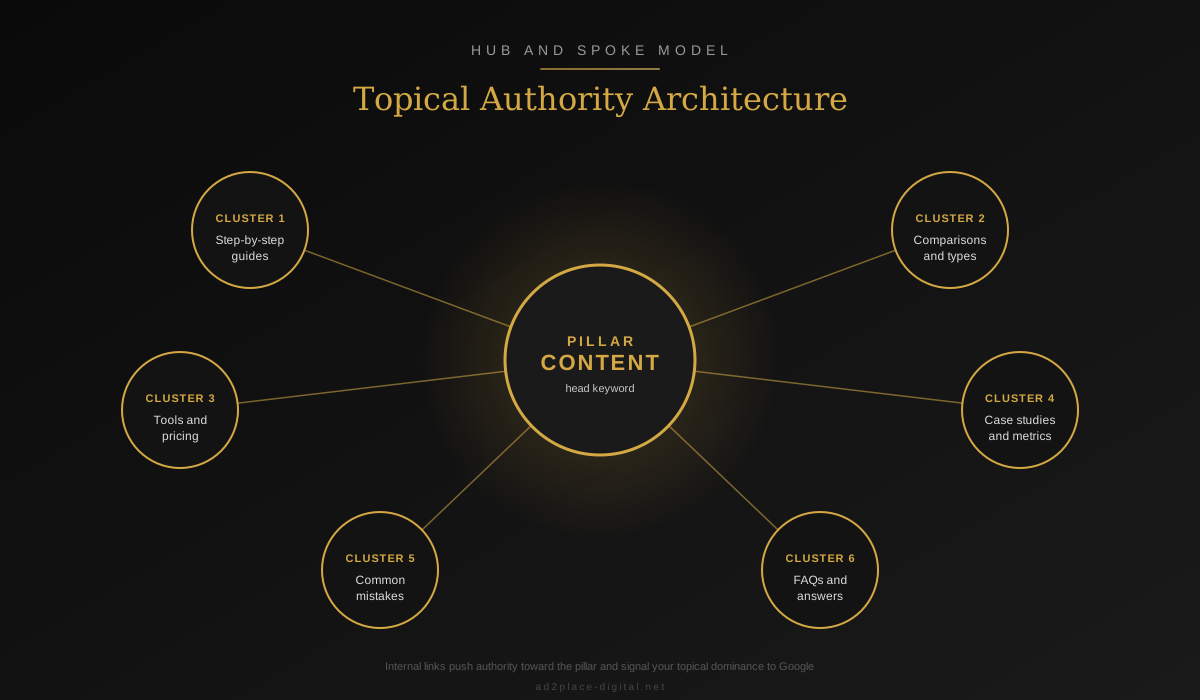
This is the visual structure you will see in any site with solid topical authority: one central pillar and between 5 and 30 satellite pieces orbiting around it. Each satellite links to the pillar with relevant anchor text, and the pillar links back to the main satellites.
Also decide the URL structure. The cleanest is /hub-topic/ for the pillar and /hub-topic/subtopic-1/ for satellites, though a flat /blog/ structure works well too if internal linking is strong.
Step 4: Create the pillar content
The pillar is a panoramic guide to the head topic. It usually runs between 3000 and 5000 words, covers all subtopics at a high level, and targets the most competitive keyword in the cluster. It does not drill deep into each subtopic (that is what satellites are for), but it does offer the best possible overview.
Recommended structure: introduction with definition, “why it matters” section, subtopic block (each with a brief paragraph + link to the corresponding satellite), FAQ section, and final CTA.
Step 5: Develop the satellite content
Each satellite goes deep on one specific subtopic, running between 1200 and 2500 words. This is where real experience kicks in: case studies, numbers, screenshots, step-by-step processes. Satellites are where you prove expertise.
Publish them at a sustainable cadence: 2-4 solid articles a month perform far better than 15 shallow ones. Google prefers sustained quality over intermittent volume.
Step 6: Link with semantic intent
Internal links are the skeleton that transfers authority inside the cluster. Rules we apply at Ad2Place:
- Every satellite links to the pillar at least once with descriptive anchor text (not “click here”)
- Satellites link to each other when semantically relevant
- The pillar links to the 5-8 most important satellites from inside the article structure
- No page in the cluster should be orphaned (no inbound links)
Step 7: Update and expand using Search Console data
Topical authority is not built and forgotten. Every 2-3 months, review Search Console: which queries drive traffic to each page? Which subintents are emerging that you are not covering? Which pages are losing positions?
Use that data to update existing content (refresh dates, add sections, improve examples) and to create new satellites that fill detected gaps. The cluster is a living organism.
Mistakes that destroy topical authority
Topic dispersion. Publishing about SEO, web design, social media, and productivity on the same blog without differentiated clusters dilutes the topical signal. If you offer multiple services, each must have its own clearly separated cluster.
Thin content. 500-word articles repeating what already exists on 20 other sites add no value. Google identifies them and penalizes the whole domain. Better 10 deep articles than 40 shallow ones.
Not updating. A 2022 article on “SEO trends” without updates signals obsolescence. Refresh the most important pieces of the cluster at least annually.
Internal cannibalization. Two articles competing for the same keyword inside the cluster weaken each other. Before publishing a satellite, verify it does not overlap with others already published.
Lack of internal linking. Having great content without connecting it is like having a library without an index. Internal linking is 40% of the benefit of a well-built topic cluster.
How to measure if you are gaining topical authority
There are three metrics we check in every monthly review of our projects.
Aggregate cluster impressions in Search Console. Sum the impressions of every URL in the cluster. If they grow month over month (even if not all URLs climb in position), you are gaining coverage and Google is showing you for more related queries.
Weighted average position of the cluster. Average position of the main cluster pages, weighted by search volume. This number should drop gradually (better positions) during the first 6-9 months.
Share of voice in your niche. Count how many cluster SERPs your direct competitors appear in vs. you. There are tools that automate this, but a quarterly manual analysis also works. The goal is to keep gaining share.
Why you do not need link building to start
At Ad2Place we do not sell link building. And we have clients with solid rankings in competitive Barcelona niches. The reason is that a well-built topical authority architecture, combined with clean E-E-A-T signals and healthy technical optimization, covers 80% of the SEO work needed for most small businesses.
Link building still makes sense in hyper-competitive niches (YMYL finance, pharma, gambling) or once you have already maxed out the ceiling your content gives you. For almost every other case, investing in building a solid cluster yields much more per euro than buying links.
If you want us to review your site’s topical architecture and tell you which cluster to build first, schedule a free SEO consultation. In 30 minutes you will have a clear map of where to start.