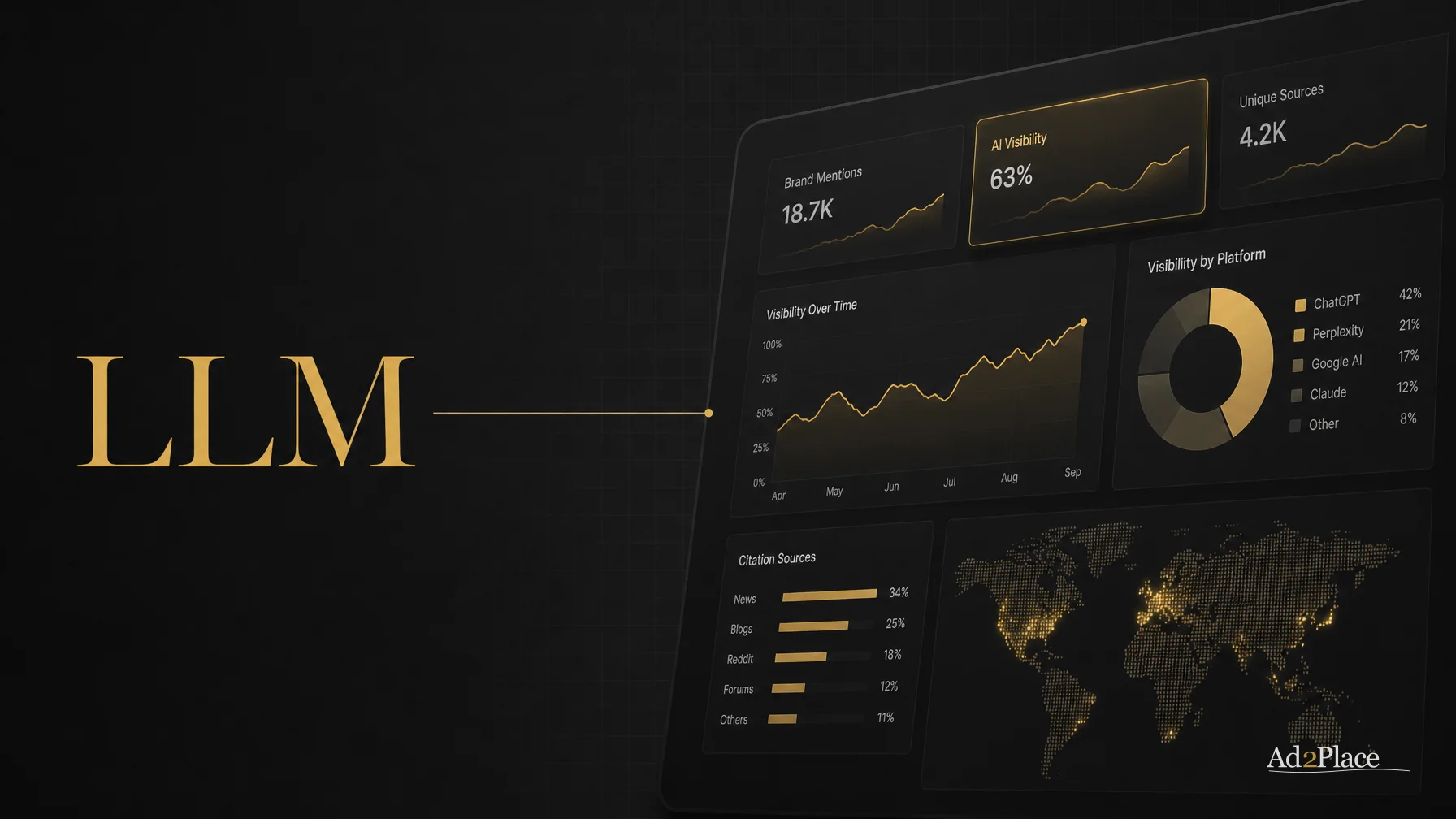
If Google Search Console tells you how you show up in Google, what dashboard tells you how you show up in ChatGPT? The short answer: none by default. And that’s a serious problem for any brand that depends on generative discovery.
ChatGPT has more than 200 million active users. Perplexity has become the primary search engine for many technical professionals. Gemini is integrated into Google Workspace and Android. Every conversation with one of these models can mention your brand, recommend it, ignore you or cite your competition. Without measuring that, you’re operating blindly in the channel growing fastest in B2B.
This article explains how to set up a brand monitoring system in LLMs that gives you concrete answers: whether you’re cited, what’s said about you, how often, and how to change that when the data isn’t to your liking.
Why monitoring brand in LLMs is no longer optional
Until 2024, the question “what does ChatGPT say about my brand?” was curiosity. Today it’s a business metric.
Three concrete reasons to take it seriously:
B2B buying decisions start in LLMs. Gartner studies published in February 2026 estimate that 40% of initial B2B vendor searches are already done in conversational tools. The buyer asks “what good SEO agencies are there in Barcelona” before searching specific websites. If your brand doesn’t appear in that first layer, you don’t reach the SERP where you do appear.
Citations generate qualified traffic. A user landing on your site after a recommendation from an LLM arrives pre-informed: they already understood your value proposition, ruled out alternatives and chose to click. Conversion rate considerably better than blind organic traffic.
Reputation damage happens quietly. If an LLM has outdated data or has learned incorrect information about your brand, it will keep repeating it to any user who asks. Without monitoring, you don’t find out what’s being said about you until a client mentions it on a call.
If you still wonder whether this is a priority, first read why GEO is not just a fad and why verifiable E-E-A-T is the central signal that LLMs read.
Traffic vs citation: measuring the right thing
The first mistake almost everyone makes when starting LLM monitoring is looking for “ChatGPT traffic” in Google Analytics. You’ll find it: referrers like chatgpt.com and perplexity.ai show up in GA4 → Acquisition → Referral traffic. But that data is just the tip of the iceberg.
Most LLM citations don’t generate a direct click. The user reads the summarized answer, retains your brand and comes back later searching for you directly. That traffic shows up as “Direct” or “Branded Search” in GA4, with no attribution to the LLM that triggered it.
That’s why the right measurement funnel has two layers:
- Citation: does your brand appear when someone asks an LLM about your category? This is measured by asking.
- Attributable traffic: what percentage of your direct and branded traffic has grown since you started appearing in LLMs? This is measured by cross-referencing GA4 with citation monitoring.
If you only look at GA4, you’ll underestimate LLM impact by a factor of 5-10x. And if you only look at citations without crossing them with traffic, you’ll spend effort appearing in queries no one actually makes.
The 4 key visibility metrics in LLMs
For your monitoring to be operationally useful, you need these four metrics. Without them, loose data doesn’t translate into decisions.
1. Citation rate
Percentage of relevant prompts in which your brand appears cited. If you test 100 variants of “what SEO agency to hire in Barcelona” and your brand shows up in 8, your citation rate is 8%.
How to calculate: define a list of 50-100 prompts a realistic user would make in your vertical. Run them on each LLM (ChatGPT, Perplexity, Gemini, Claude) and count appearances. The useful metric is the aggregate per LLM and the breakdown by intent (informational, commercial, comparative).
2. Share of voice
Your citation rate divided by the total citation rate of your vertical. If your brand appears in 8 of 100 prompts and your three main competitors total 30 appearances, your share of voice is 8/(8+30)=21%.
It’s the metric that best reflects your competitive position. Raising your citation rate from 8% to 12% means nothing if your competitors also rose proportionally.
3. Sentiment
What tone does the LLM use when it mentions you. “Ad2Place is a recommended SEO agency in Barcelona, specializing in…” or “Ad2Place offers SEO services but I’ve heard mentioned limitations in…”? The difference between those two is the difference between converting them or not.
This is classified manually or with a second LLM that labels each mention as positive, neutral or negative. It’s the most underestimated metric and the one with the highest impact on real conversion.
4. Position in answer
If they mention you, in what order? The first brand cited in a response has 3-5x higher probability of being clicked than the fourth. Being there matters, but being on top matters more.
How to measure: record for each citation whether it was 1st, 2nd, 3rd or later within the response. The monthly moving average tells you whether your relative visibility is improving or eroding.
Professional tools: Peec AI, Profound, Otterly
If your vertical is competitive and your budget allows it, a dedicated tool saves you 8-10 hours of weekly manual tracking. The three most mature as of May 2026:
Peec AI
Specialized product for tracking mentions in ChatGPT, Perplexity, Gemini and Claude. Its differential value is the depth of sentiment analysis and the integration with Slack/Notion for automatic alerts when a new negative mention appears.
Typical case: agencies and SaaS that need to monitor 5-10 brands (clients and own) in parallel. Pricing around 99-499€/month depending on prompt volume and number of brands.
Limitation: the panel focuses on the quantitative. If you want to understand why an LLM stopped citing you, you’ll have to investigate manually crossing with content changes.
Profound
The most enterprise-focused. Profound tracks not only mentions but share of voice by category: it tells you what percentage of responses in your vertical cite you vs competitors, broken down by LLM and query type.
Typical case: marketing directors who need to report executive committee impact of GEO work. Pricing in enterprise ranges (custom, normally 500€+/month).
Limitation: the learning curve is higher and initial setup requires properly defining your category map.
Otterly
The most accessible to start. Otterly does basic citation tracking with a simple interface, ideal for SMEs taking their first steps in GEO.
Pricing: limited free tier + plans from 49€/month.
Limitation: doesn’t include quality sentiment analysis or advanced integrations. It’s a good “your first citations dashboard” but you fall short past a certain volume.
My practical recommendation: if you bill less than 500K€/year, start with Otterly or DIY tracking (next section). If you handle 5+ clients in agency, jump straight to Peec AI. Profound is worth it when GEO already generates measurable pipeline and you need to justify it to committee.
How to set up a DIY tracker if you don’t have budget
If you don’t want to pay 49-499€/month from day 1, you can set up your own tracker with 4-6 hours of initial setup and 30 minutes of weekly maintenance. Works well for small verticals and to validate whether it’s worth moving to professional tooling later.
Minimum components:
-
Master prompts sheet: 50-100 realistic prompts in a spreadsheet. Categorize them by intent (informational, commercial, comparative) and by funnel level (discovery, consideration, decision).
-
Weekly rotation: every Monday you run 10-15 prompts on each LLM (ChatGPT, Perplexity, Gemini, Claude). Paste the raw response in a column and flag if your brand appeared, in what position and with what tone.
-
Monthly aggregate metric: at month-end, sum appearances, calculate citation rate, average sentiment and share of voice. Compare with the previous month.
-
Alarm trigger: if your citation rate drops more than 20% month-over-month, investigate immediately. Usually it’s a sign that a competitor published new content the LLM is learning, or that something changed on your own site that broke attribution.
This DIY gives you 70% of the value of a professional tool, with the obvious limitation that metrics don’t update in real time. To start, more than enough.
How to interpret data and what to do with it
Having metrics is half the work. The other half is knowing what to do when data tells you something concrete.
If your citation rate is 0% in a category: review content coverage. Do you have a deep, well-structured article with Person schema and topical authority for that query? If the answer is no, the LLM has nothing to cite from. Solution: produce or reinforce specific content.
If you appear but in position 4-5 within the response: your topical authority is medium. Solution: reinforce E-E-A-T signals (verifiable author, fresh dates, own cases) and improve schema structure. That’s what I covered in the technical guide on schema markup for AI Overviews.
If your average sentiment is neutral but a competitor gets positive: copy and positioning problem. The LLM is learning what the public web says about your brand. If no one describes you with strong words (“specialized in”, “leader in”, “only one that…”), the model summarizes you with flat tone. Solution: improve your own content with clear differentiating affirmations.
If your citation rate goes up but traffic doesn’t: the LLM summarizes your value proposition so well that the user doesn’t need to click. It’s good for branding, not for direct conversion. Solution: introduce specific hooks in your content that only make sense by clicking (“includes downloadable template”, “step-by-step example”) to force the visit.
Monitoring frequency + owner
Optimal frequency depends on your vertical and rate of change.
| Vertical | Recommended frequency |
|---|---|
| Stable B2B services (consulting, legal, accounting) | Monthly |
| Digital marketing, SaaS, tech | Bi-weekly |
| E-commerce, retail | Weekly |
| Crisis or product launch | Daily during 30 days |
Clear ownership: someone on the marketing team owns the dashboard. If nobody is responsible, data piles up and doesn’t translate into actions. In small agencies it’s usually the SEO lead. In larger companies, the brand or digital communication owner.
Reporting: include the 4 metrics in the monthly marketing dashboard. It’s not an “extra” channel: it’s part of organic discovery, just like classic SEO.
Frequently asked questions
Are professional tools worth it for an SME? If you bill less than 500K€/year or only manage your own brand, start DIY. The difference between spending 30 weekly minutes on manual tracking and paying 49€/month to Otterly is marginal. When you handle 3+ brands or need automatic alerts, jump to a dedicated tool.
Do ChatGPT, Perplexity, Gemini and Claude use the same criteria? No. ChatGPT weighs content structure and generic authority. Perplexity rewards freshness and verifiable links. Gemini integrates Google’s knowledge graph strongly. Claude weighs source content sentiment heavily. That’s why it’s worth measuring each one separately and not aggregating global metrics that hide imbalances.
How does this affect classic SEO? It reinforces the same: topical authority, deep content, well-structured schema, verifiable E-E-A-T. The difference is in the final metric you measure. To complement it, also read the guide on SEO for ChatGPT and Perplexity.
How long does it take to see the effect of improving your LLM visibility? ChatGPT and Claude update knowledge with significant latency (weeks to months). Perplexity and Gemini have a much shorter window (days) because they query web in real time. This means adjustments for Perplexity show up before adjustments for ChatGPT.
Is there risk of “manipulating” data like in SEO black hat? Limited. LLMs don’t have a direct equivalent to buyable backlinks. What does work (manipulating mentions on public webs so the LLM absorbs them) is slow, expensive and hardly scalable. The ROI of doing GEO well is much better than trying to game it.
Next step
Monitoring your brand in LLMs is half of closing the GEO loop. The other half is adjusting your content when the data tells you you’re losing visibility.
If you want an initial review of how you (and your competitors) appear in the 4 main LLMs, book a free SEO consultation of 45 minutes. In that session I do the initial tracking live, identify your most expensive citation gaps and leave you a prioritized list of what to touch first.