Quick summary: the 4 real Google Ads investment ranges
If you are reading this, you have probably asked yourself the most uncomfortable question in digital marketing: how much do I need to invest for Google Ads to actually work? And you have probably seen answers ranging from “you can start with €100/mo” all the way to “you need at least €5,000/mo for it to be worth it”. Both are half-truths that confuse more than they help.
I have spent more than a decade running Google Ads campaigns across very different sectors — from mortgage brokers to premium chocolate ecommerce, including home renovation and local services — and the reality of pricing is more nuanced than any “agency that promises results from €50/mo” will tell you. In this article I lay out the real 2026 ranges and the math behind them, with no jargon.
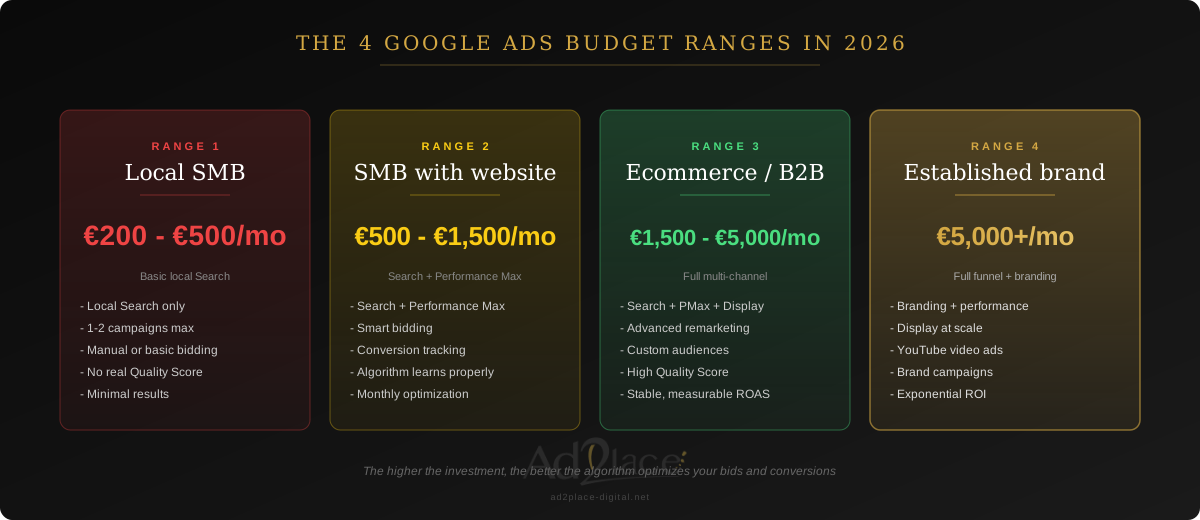
These are the four real investment ranges in the market in 2026:
| Range | Ad spend | Campaign type | Best for |
|---|---|---|---|
| Local SMB | €200 – €500/mo | Basic local Search | Neighborhood business starting out |
| SMB with website | €500 – €1,500/mo | Search + Performance Max | SMB with product and converting site |
| Ecommerce / B2B | €1,500 – €5,000/mo | Full multi-channel | Online stores and serious B2B |
| Established brand | €5,000+/mo | Full funnel + branding | Companies with catalog and brand |
Before going deep into each range, there is one concept you must understand: the real price of Google Ads is not what you pay Google. It is what you pay Google plus what you waste through bad optimization plus what the agency charges (if there is one). That sum is the only number that matters. I break it down below.
How Google Ads pricing REALLY works
Unlike a service with a fixed rate, Google Ads works as a real-time auction. Every time someone searches on Google, dozens (or thousands) of advertisers bid to appear in the top paid results. Your cost depends on three factors that multiply together: CPC × Quality Score × your level of optimization.
Cost per click (CPC): what determines it in 2026
CPC is what you pay Google every time someone clicks your ad. But that price is NOT fixed. It changes in every auction depending on:
- Active competition at that exact moment. The CPC at 8 a.m. can differ from the CPC at 10 p.m.
- Your Quality Score (more on this below).
- Keyword type. A niche keyword like “technical SEO consultant Pamplona” might cost €0.30/click. A competitive keyword like “divorce lawyer Madrid” can hit €25/click.
- Match type. Exact match (
[red shoes]) is usually more expensive but more relevant than broad match (red shoes). - Device and location. Mobile is often cheaper than desktop in some sectors.
Average CPC ranges in Spain in 2026:
- Niche or hyper-local sectors: €0.20 – €0.80
- Standard SMB services: €0.80 – €4
- Competitive sectors (legal, health, finance): €5 – €15
- Hyper-competitive sectors (insurance, specialized lawyers, dental implants): €15 – €25+
Quality Score: the lever that cuts your CPC in half
Google assigns each keyword in your account a Quality Score from 1 to 10. This number is the most underrated lever in SEM and the one that separates accounts that perform from accounts that burn money.
Quality Score is determined by three factors:
- Historical CTR (clicks divided by impressions)
- Ad relevance to the keyword
- Landing page quality and experience (speed, relevant content, mobile-friendly)
Why it matters so much: an account with average Quality Score of 8 can pay half the price of an account with Quality Score 4 for the same click, in the same auction. That is, two advertisers bidding on the same keyword can pay €1 and €2 respectively, depending on Quality Score. It is mathematically the highest-ROI lever available in Google Ads.
Improving Quality Score requires continuous work: rewriting ads, segmenting keywords into small thematic groups, improving landing pages, A/B testing copies. It is what separates a professional agency from “a technician who clicks buttons”.
Daily budget vs real spend (why they never match)
When you set up a campaign in Google Ads, you assign a daily budget. But the real spend on any given day can be up to double that budget. Meaning: if you set €30/day, some days Google may spend €60. It compensates other days by spending less. At month end, the average matches daily budget × 30.4. But you will never see it match day by day.
This matters because many people think they have done something wrong when they see a day with double the spend. It is not an error, that is how Google Ads works. To avoid panic: always check your monthly spend, not daily.
Agency management fee (3 typical models)
If you work with an agency, add their fee to your ad spend. There are three typical models in the market:
- Model 1 — Percentage of spend: between 10% and 20% of monthly ad spend. If you invest €1,000, the agency charges €100-€200. The most popular model but creates a conflict of interest: the agency earns more the more you spend, not the better they optimize.
- Model 2 — Fixed monthly fee: between €300 and €1,500/mo depending on complexity. Independent of ad spend. Cleaner because it aligns incentives: the agency focuses on optimization, not on getting you to spend more.
- Model 3 — Results-driven hybrid: minimum fee + variable based on KPIs (CPL, ROAS, conversions). The fairest model when there is trust, because it ties price to actual performance. This is the one we recommend for clients with clear metrics.
At Ad2Place we work with fixed fee or hybrid. Never with percentage of spend, because we want you to trust that every optimization decision is made for your ROI, not to inflate our invoice.
Range 1: Local SMB with small budget (€200-€500/mo)
What you actually get
In this range Google Ads serves one very specific purpose: showing up when someone searches for a local service in your area and needs an immediate solution. A dental clinic, a mechanic shop, an emergency plumber, a neighborhood yoga studio.
What you receive:
- 1-2 Search campaigns very focused on your geographic area
- Manual bidding or basic strategy like “Maximize clicks”
- Decent CTR if you have few highly focused keywords
- Basic conversion tracking (calls, forms)
- No budget for Performance Max or Display
Who this range makes sense for
For very local businesses with low CPC (under €1.50/click) and a decent conversion rate. If your sector has an average CPC of €5, with €300/mo you only buy 60 clicks and the math does not work (you need at least 30-40 conversions per month for the algorithm to learn).
Real limitations and when it does NOT work
- No room for Google’s algorithm. Smart bidding needs conversion data to optimize, and with 60 clicks per month there is barely any data.
- You cannot compete in expensive sectors. If your CPC is above €3, this range is unviable.
- No budget to experiment. Any test gets cancelled out by low volume.
If your average CPC is above €2.50, jump straight to Range 2. It is the most profitable thing you can do with your money.
Range 2: SMB with professional website (€500-€1,500/mo)
What you get in this range
Here Google Ads starts to be a real acquisition channel. You can structure campaigns properly, gather enough conversions for the algorithm to learn, and combine multiple formats.
What you receive:
- Search + Performance Max running in parallel (the two jewels of modern Google Ads)
- Smart bidding (Maximize conversions, Maximize conversion value, tCPA, tROAS)
- Full conversion tracking with monetary values
- Real Quality Score because there is enough volume for it to matter
- Monthly optimization with A/B testing of ads and landing pages
- Basic remarketing to re-engage visitors who saw your site but did not convert
Who this fits
For an SMB with a clear product or service and a website that converts decently. It is the range where most B2B businesses and professional services find profitability. If your website does not convert (sales or leads), invest in improving the website before investing in Google Ads — I cover this in detail in my guide on how much a professional website costs.
The strategy we typically recommend
- 70% of budget on Search with transactional and brand keywords
- 20% on Performance Max focused on conversions
- 10% on remarketing for recent visitors
This split is adjusted every month based on actual performance. What works gets scaled. What doesn’t gets discarded fast.
Range 3: Serious ecommerce or B2B (€1,500-€5,000/mo)
What you get in this range
Here we enter full multi-channel territory. The budget allows you to activate practically every Google Ads format and combine them in a coherent strategy.
What you receive:
- Search + Performance Max + Display working in sync
- Dynamic remarketing with product catalogs (essential for ecommerce)
- Custom audiences (recent visitors, past customers, lookalikes)
- Shopping campaigns for ecommerce (often the highest ROAS format)
- High and consistent Quality Score
- Measurable and predictable ROAS (typically 3x-8x depending on sector)
- Weekly or biweekly optimization with real-time metrics dashboards
What kind of company this fits
- Ecommerce with a 50+ product catalog and reasonable margins (>30%)
- B2B with short sales cycle (consultations, demos, qualified leads)
- Professional services with high LTV (firms, clinics, consultancies)
Realistic expected ROAS
In this range the typical ROAS (return on ad spend) sits between 3x and 8x, depending on the sector. That is: for every euro invested in Google Ads, you recover between €3 and €8 in revenue. High-margin sectors (professional services) tend to be at the top; commoditized product ecommerce, lower.
If your ROAS is below 2x after 3 months, something is wrong: either the product is not validated, or the website is not converting, or the Google Ads strategy doesn’t fit your business. In any of those three cases, before increasing budget, fix the cause.
Range 4: Established brand with volume (€5,000+/mo)
What you get in this range
From €5,000/mo we are in another league. Google Ads stops being just an acquisition tool and becomes a lever combining growth and branding. This is where Google’s algorithm operates at full capacity.
What you receive:
- Branding + performance integrated (campaigns that generate demand + campaigns that capture it)
- Display at scale with interest and behavior targeting
- YouTube Ads (video) to build brand awareness
- Brand campaigns to protect your brand from competitors
- Custom high-intent audiences based on first-party data
- Continuous A/B testing of hundreds of ad variants
- Real multi-touch attribution with Google Analytics 4 linked
- Dedicated team with real-time dashboards
When this range is justified
When you have already validated the business (sales/leads come in predictably) and want to scale aggressively but in a controlled way. It makes no sense to start in this range without having validated product-market fit first — that would be burning money.
Why ROI improves exponentially at this level
More budget means a better algorithm. Google needs data to optimize automated bidding. With 30-40 conversions/month the algorithm barely learns. With 200-500 conversions/month (typical of Range 4), it learns real patterns and starts finding opportunities a human would never see: combinations of time of day + device + location + audience that convert 5x better than average.
This is the moment where Google Ads goes from “another tool” to “the best salesperson on your team”. But to get here you need to have gone through the previous ranges without shortcuts.
The 5 mistakes that inflate your Google Ads cost without you noticing
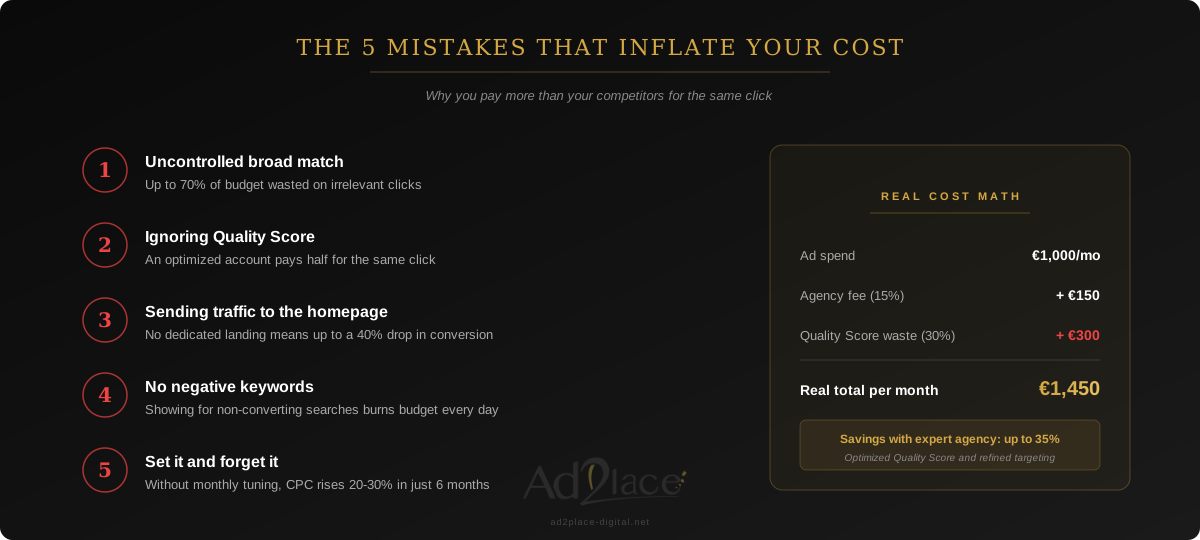
I have audited more than 100 Google Ads accounts in my decade in digital marketing and the same mistakes appear over and over. These five are the ones that inflate the real cost without the advertiser realizing.
1. Uncontrolled broad match
Broad match allows Google to show your ad for any search it considers “related”. The problem: Google interprets “related” very generously. An account without negatives and broad match can spend up to 70% of budget on clicks that will never convert because they come from irrelevant searches.
Fix: weekly search terms audit and aggressive addition of negatives in the first months.
2. Ignoring Quality Score
As explained above, Quality Score can cut your CPC in half. But most advertisers do not even look at it. It is the most underrated asset in SEM.
Fix: review Quality Score of your top 20 keywords every month and specifically work on those below 7.
3. Sending all traffic to the homepage
Your homepage is built for visitors who already know your brand. Someone arriving from Google Ads searching “urgent labor lawyer Barcelona” needs to land on a dedicated landing page that talks about exactly that, not on your homepage with a 10-service menu.
Data: without a dedicated landing, conversion rate drops up to 40% compared to an optimized landing.
If you want to understand how to build landings that convert, see our guide on common Google Ads mistakes where we go deep on this point.
4. No negative keywords
Negative keywords are the filter that prevents your ad from appearing in irrelevant searches. Without them, an SMB that sells “ergonomic office furniture” can end up paying for clicks from people searching “cheap second-hand office furniture” or “IKEA office furniture”.
Fix: initial negative list of 50-100 terms + weekly search terms review in the first 3 months.
5. Set it and forget it
The most expensive mistake of all. A Google Ads account is not a microwave. You do not configure it once and let it run. Without monthly optimization the CPC rises 20% to 30% in 6 months because competition improves, auction costs evolve and your ads lose freshness.
Fix: mandatory monthly review with A/B testing of ads, bid adjustments, negative term exclusion, new audience tests.
How much does an agency charge to manage Google Ads?
If you decide to work with an agency, these are the typical models in Spain in 2026 and when to choose each one.
Model 1 — Percentage of spend (10-20% typical)
- When it makes sense: advertisers with very variable monthly budgets where a fixed fee does not fit
- When it does NOT make sense: stable accounts. Creates a conflict of interest (the agency earns more the more you spend, not the better they optimize)
- Typical range: 10-20% of ad spend
Model 2 — Fixed monthly fee (€300-€1,500)
- When it makes sense: most SMBs with stable budgets. Cleaner and more predictable
- When it does NOT make sense: large accounts (€10,000+/mo) where a fixed fee does not compensate the real work
- Typical ranges:
- Simple account, 1-2 campaigns: €300-€500/mo
- Medium account, 3-5 campaigns: €500-€1,000/mo
- Complex multi-channel account: €1,000-€1,500/mo
Model 3 — Results-driven hybrid
- When it makes sense: when there is trust between client and agency, and clear metrics (CPL, ROAS, conversions)
- Typical structure: minimum fee (€300-€500) + variable on KPIs achieved
- It is the model that best aligns incentives and the one we recommend for clients with solid data
What a good professional management covers
- Initial account audit (if it exists) or full setup from scratch
- Keyword strategy and campaign structure
- Ad copywriting (minimum 4-6 variants per group)
- Conversion tracking setup (Google Tag Manager + GA4)
- Monthly optimization: bids, negatives, A/B testing, audiences
- Monthly reporting with real metrics (no vanity metrics)
- Direct communication: no tickets, no intermediary account managers
When NOT to hire an agency (mathematical threshold)
If your ad spend is below €300-€500/mo, hiring a professional agency is NOT profitable. The fee eats all the margin and there is no volume for optimization to compensate. In that case, the smart thing is to do it yourself with tutorials and free Google Skillshop certifications.
From €1,000/mo of ad spend onwards, a professional agency typically recovers its fee through Quality Score optimization and CPA reduction. That is the threshold where the math starts to work.
How we work at Ad2Place: transparent management, no lock-in
At Ad2Place Digital we run Google Ads for clients in very different sectors: mortgage brokers, industrial manufacturers, premium brands, SaaS ecommerce and local services. What they all have in common is that they invest because the campaigns generate measurable ROI, not because they are afraid to stop.
We work with three principles:
- Fixed fee or results-driven hybrid. Never percentage of spend. If we recommend you invest more, it is because the data justifies it, not because we want to bill more.
- No lock-in contracts. If at any point we stop adding value, you can leave next month. That freedom is what forces us to deliver results every month.
- Direct communication with José. No intermediate account managers, no tickets. You speak with me, and the person managing your account is the same person optimizing your campaigns every week.
Before starting any project we deliver a written closed budget with the scope of work, target KPIs and pricing model agreed. No fine print.
If you want to know whether Google Ads fits your business and how much you should really invest, book a free 30-minute consultation. On the call we analyze your sector, your competition and your margin, and we tell you honestly whether Google Ads is for you or whether you should focus on SEO, social media or a combination.
Frequently asked questions about Google Ads pricing
How much does Google Ads cost in 2026 for an SMB?
In 2026 an SMB can invest from €200/mo on a basic local Google Ads campaign up to €5,000+/mo for multi-channel strategies covering Search, Performance Max and Display. The real price depends on your sector competitiveness, the average CPC of your keywords, and whether you manage campaigns yourself or with an agency. For effective SEM in competitive sectors, the realistic minimum is €500-€1,000/mo in ad spend.
How much does an agency charge to manage Google Ads?
Agencies typically charge for Google Ads management with three pricing models: percentage of ad spend (10-20% standard), fixed monthly fee (€300-€1,500/mo depending on complexity), or hybrid model (minimum fee + variable on results). At Ad2Place we work with a fixed or results-driven hybrid fee, no lock-in contracts, and a written closed budget before starting.
How much does a click cost on Google Ads in Spain?
The average CPC on Google Ads Spain in 2026 ranges from €0.20 in niche sectors up to €25+ in highly competitive sectors like lawyers, insurance, dentists or home renovation. For most SMBs, CPC sits between €0.80 and €4. The real cost depends on Quality Score, keyword match types, landing page quality and the auction position at the moment.
What is the minimum budget I need to start with Google Ads?
For Google to have enough data to optimize automated bidding, you need at least 30-40 conversions per month, which typically means a minimum budget of €500-€1,000/mo in sectors with average CPC. If you invest less than €200/mo, the algorithm cannot learn and ads underperform. It is mathematical: below a certain threshold, Google Ads simply does not work.
Why do two companies pay different prices for the same click?
Because of Google Quality Score. The system rewards accounts with high relevance between keyword, ad and landing page, and strong historical CTR, with lower CPCs. A well-optimized account can pay half the price for the same click than a poorly structured one. Improving Quality Score is the most effective lever to reduce cost without touching the budget.
Is it better to manage Google Ads myself or hire an agency?
It depends on your investment volume and the time you can dedicate. If you invest less than €300/mo with one simple campaign, you can do it yourself with tutorials. If you invest more than €1,000/mo or manage multiple campaigns, a professional agency typically recovers its fee through Quality Score optimization and lower cost per acquisition. The typical profitability threshold of hiring an agency is around €1,000/mo of ad spend.
Next step: book a free consultation
If after reading this guide you still have doubts about how much to invest in Google Ads or whether your sector is viable, book a free 30-minute consultation. We analyze your business, the average CPC in your sector and your margins, and tell you honestly whether Google Ads is the best investment for you right now or whether you should focus on SEO, social media or a combination.
And if you already know you want to launch campaigns with a professional partner, see our Google Ads management service in Barcelona where we detail how we work step by step. To go deeper into the most common mistakes that may be killing your profitability right now, also check our common Google Ads mistakes guide, and if today’s article was useful, I recommend the complementary How Much Does a Website Cost in Barcelona in 2026?, from the same topic cluster on real pricing in digital marketing.