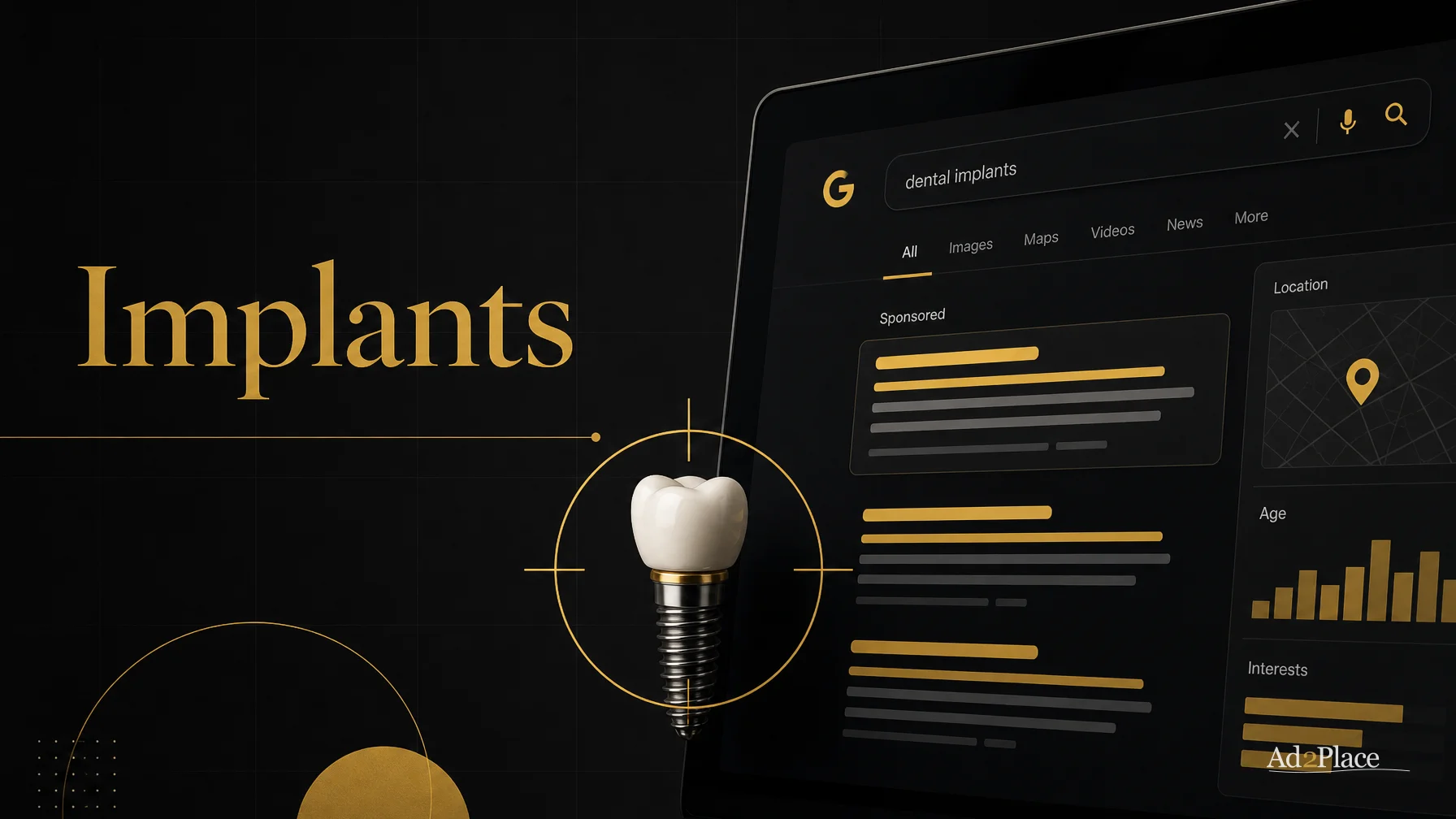
This is the second satellite of the dental cluster. The pillar on digital marketing for dental clinics summarizes the five traps that make 80% of clinics burn budget on Google Ads. The first satellite covers the organic channel (local SEO + Google Business Profile). This piece is the tactical detail of the paid channel for a clinic’s highest-value treatment: how to build Google Ads campaigns for dental implants that bring in first visits without torching €1,500 a month on irrelevant clicks.
Implants are the treatment where Google Ads makes the most sense and carries the most risk at once: a patient is worth a fortune (€2,000-€30,000 depending on the case), but the CPC is among the most expensive in dental and the traps are costly. If you’re going to invest in Ads for implants, this is what to touch and in what order.
Why implants deserve their own campaign (always)
The most common and most expensive configuration mistake is putting implants in a generic “Dentist [city]” campaign alongside cleanings, root canals and check-ups. Don’t do it.
The reason is economic. A “dental cleaning” search and a “dental implant” search have patient values two orders of magnitude apart: a €60 ticket versus €2,000 or more. If they share a campaign, they share budget and bid, and the algorithm — which optimizes for aggregate conversions, not value — splits your money without distinguishing which one is profitable. The typical result: you spend 70% of the budget on cheap cleaning and prophylaxis clicks that barely leave margin, and you run out of funds to bid on the implant click that actually pays the payroll.
Isolating implants in their own campaign gives you three controls you don’t have any other way:
- Own bid: you can afford an €8-€12 CPC on implants because the return justifies it, while keeping the cleaning campaign at €2-€3.
- Ring-fenced budget: implant money isn’t eaten by the volume of cheap searches.
- Specific negatives: implants need a negative list that makes no sense in other campaigns (we’ll get to it).
Recommended campaign structure
For a clinic starting out in implant Ads, the best-performing structure is deliberately simple:
- One Search campaign exclusively for implants, geo-targeted to your real area (a 15-25 minute drive radius, not the whole province).
- 2-3 ad groups by intent: “dental implants” (generic commercial), “dental implant price / financing” (comparison shopper) and, if you offer it, “immediate-load implants / all-on-4” (high intent, high ticket).
- Exact and phrase match, never broad (reason in the next section).
- No Performance Max in the first quarter. PMax is powerful once you have 100+ conversions/month with clean tracking; without that base it’s a black box spreading your budget across YouTube and Display with no idea whether it converts. For implants, start with pure Search.
Each ad group points to its own landing page (not the home page), and all with call tracking live from day one.
Negative keywords: the filter that saves the budget
This is where implant profitability is won or lost, and it’s sector-specific because “implant” is an ambiguous word. Without a serious negative list, you pay for clicks from people who aren’t looking for what you offer.
Essential negatives in a dental implant campaign:
- Other meanings of “implant”:
hair,cochlear,breast,chest. Without these, you pay for hair or breast implant searches. - Non-commercial / training intent:
course,training,masters,what is,how is it done,university. - Free / public-health seekers:
free,public health,subsidy,national health. - Undecided browsers (optional, by volume): a bare
priceif you prefer to filter window-shoppers, though implant price-searchers are usually decided. - Competitors (optional): other clinic or chain names, if you don’t want to pay for traffic already searching for them.
Review the search-terms report weekly the first month and every two weeks after. Every irrelevant term that shows up becomes a new negative. This weekly hygiene is what separates an account with an €80 cost-per-lead from one at €250.
Call tracking: without it, you optimize blind
70% of implant patients call instead of filling out a form. It’s an expensive treatment and people want to talk to a person before taking the step. If your campaign only measures forms, you’re optimizing with 30% of the real information and the algorithm learns from incomplete data.
Two ways to solve it, from lighter to more powerful:
- Google Forwarding Numbers: Google shows a virtual number in the ad that redirects to your real phone and logs the call as a conversion (configurable minimum duration, e.g. 60 seconds to filter hang-ups). It’s the quick option and enough to start.
- Enhanced Conversions integrating the CRM: when reception marks in the CRM that a patient came from Ads and booked a first visit, that data goes back to Google Ads. That’s what lets the algorithm optimize for real first visits, not clicks. It takes some setup, but it’s what makes a mature implant account lower its cost per lead month over month.
Without call tracking, any optimization decision is guessing. With it, you see which keyword, which ad and which time of day bring the calls that turn into patients.
Implant landing pages: converting without breaking compliance
Implant Ads traffic should never go to the home page. The home mixes services, team, blog and contact, and the expensive implant click gets diluted. It needs a dedicated landing.
An implant landing that converts (4-9% versus the home page’s 1%) has:
- A headline that matches the search: “Dental implants in [city]” — no paraphrasing, to keep the message match.
- The named clinician with photo and training: in implants, trust in the specific professional is decisive.
- The technique and implant brand you use, in plain language, plus the number of sessions and the real warranty.
- In-house financing if you offer it (interest-free with the clinic, not a bank): a huge differentiator against chains.
- A short form + a prominent phone number with call tracking, both visible without scrolling.
- Compliant social proof: verifiable reviews; before/after only with the patient’s explicit consent, no retouching, and a note that every case is different.
And the point almost no one handles: health-advertising compliance in the ad and the landing. No “the best dentist in [city]”, no “guaranteed results”, no “100% complication-free implant”. Those phrases can trigger a professional-association file and, on top of that, Google can reject the ad or suspend the account under its healthcare policy. Both the ad copy and the landing copy must pass a compliance review before going live. The edge isn’t in promising more, it’s in being more concrete and more verifiable than the chain across the street.
Realistic budget and bidding
Numbers to work with for implants (they vary by area and competition):
- CPC “dental implant [city]”: €4-€14. More expensive than the dental average.
- Starting budget: €800-€1,200/month for at least 10-12 weeks. Below €700/month there isn’t enough data to optimize.
- Target cost per first visit booked: €60-€120. Sounds high until you compare it to the value of an implant case.
- Bidding strategy: start on “Maximize clicks” with a capped max CPC for the first 2-3 weeks to gather data, and move to “Maximize conversions” or “Target CPA” only once you have 15-30 conversions logged with call tracking. Jumping to automated bidding without data is handing control to the algorithm before it knows what a good conversion is.
The mental key: in implants you don’t optimize for cost per click, you optimize for cost per patient in the chair. A high CPC with a good conversion rate is cheaper than a low CPC that doesn’t close.
How to measure real profitability
Three metrics, in this order:
- Cost per first visit booked (target €60-€120). This is the metric that says whether the campaign works.
- First-visit-to-accepted-treatment-plan rate (healthy at 25-45%). Depends on your sales team, not Ads.
- Acquisition cost per closed implant case versus its ticket. This is the one that says whether the channel is a business.
If cost per visit is under control but you don’t close treatment plans, the problem isn’t Google Ads: it’s the sales consultation, the price or the follow-up. No acquisition channel fixes a sales process that doesn’t convert — and it’s honest to tell you that before you spend three months blaming the campaign.
Typical mistakes that ruin an implant account
What I see most when auditing dental campaigns that spend without results:
- Implants mixed with other treatments in a generic campaign.
- Broad match blowing the budget on “hair implant” and informational searches.
- No call tracking, measuring only 30% of real conversions.
- Traffic to the home page instead of a dedicated landing.
- Performance Max in the first month, with no clean conversion data.
- Ads and landings that break compliance (“the best”, “guaranteed”).
- Switching to automated bidding before having 15-30 logged conversions.
- Not reviewing search terms weekly in the first month.
Google Ads and local SEO don’t compete, they complement
A strategic nuance to close. Implant Ads cover the short term: you switch the campaign on and first visits start in 2-4 weeks. Local SEO covers the medium and long term: it takes 4-9 months but, once ranked, every patient is free. The ideal combination is Ads to have leads from month one while local SEO matures, then gradually reducing Ads dependence as the organic gains strength. Depending only on Ads is renting your acquisition forever; depending only on SEO is not billing for the first six months. Both together, well measured, is how you build a clinic that doesn’t rely on a single tap.
If you’d like us to review your dental Ads account
At Ad2Place we manage Google Ads for health businesses in Barcelona and its metropolitan area. We don’t take on accounts whose CPA we can’t genuinely improve: if your setup is already healthy, we’ll tell you; if it’s burning budget, we’ll show you exactly where. If you run a clinic, here is the detail: digital marketing for dental clinics.
Book a 45-minute consultation with no commitment with José and we’ll review live your Google Ads account, your campaign structure, your negatives and your implant landing. Whether you end up working with us or not, you leave with a clear diagnosis of what’s torching your budget and in what order to fix it. No lock-in and with scrupulous respect for health-advertising regulation.