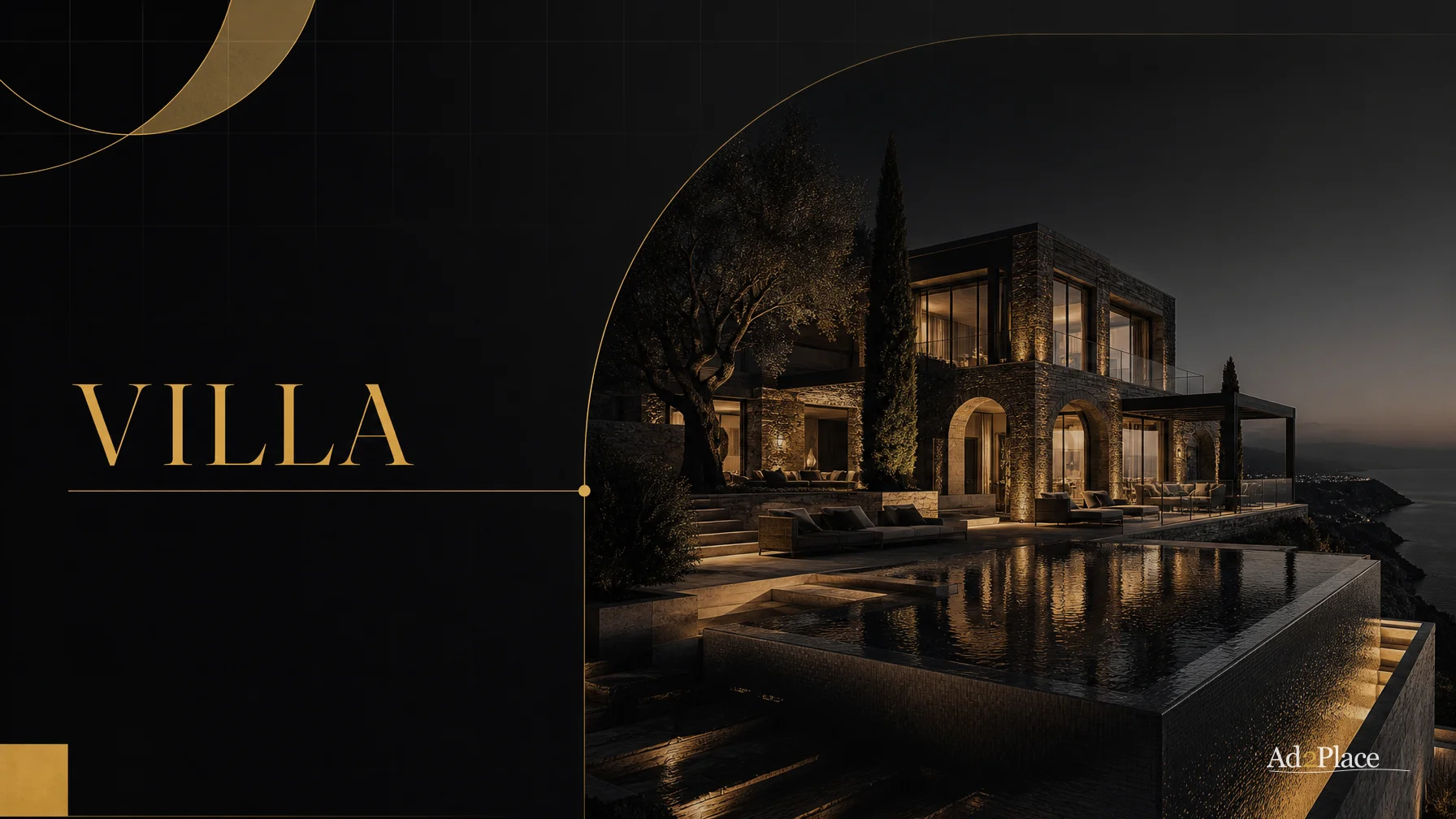
This is the third and final satellite of the renovation cluster. The pillar on digital marketing for renovation companies covers the four channels that pay off in standard residential. The local SEO satellite explains how to appear for “full renovation [your city]”. The Google Ads satellite goes deep into campaign setup. This article covers a completely different niche: how to acquire clients for premium villa renovations with average ticket above €80,000-150,000, mostly with international or high-net-worth profile.
If you come from standard residential and want to make the jump to villa renovations, premium second homes or heritage rehabilitation, this article explains why the pillar channels are not enough and which multichannel actually works for this niche.
Why the premium villa client is not the standard residential client
The most common mistake when trying to enter premium is thinking it is “the same thing but with bigger budget”. It is not. The client of a €200,000 villa renovation behaves radically differently from the client of a €35,000 flat renovation.
They do not search in a hurry. Standard residential clients usually have a fixed deadline (move-in, inheritance, child leaving, partner moving in). Premium clients research for 4-9 months before requesting the first quote. They have no rush, they have demands.
They compare against reference publications, not local companies. Residential clients compare three companies in their city. Premium clients compare your mental portfolio against the projects they have seen in Architectural Digest, House & Garden, Houzz, the Pinterest board of the designer they follow, and the villa of their friend in Ibiza/Mallorca. If your portfolio does not hold up to that visual comparison, they eliminate you in 30 seconds without asking for a quote.
They ask for references before price. Residential asks “how much will it cost?”. Premium asks “what projects have you done recently?”, “who designed this other build?”, “can I speak to the owner of the project you show here?”. Price is the last question, not the first.
They are more frequently international. Especially in Ibiza, Mallorca, Marbella, Costa Brava and premium rural enclaves (Empordà, Sierra de Madrid). The client lives partially abroad. If your website is only in Spanish, you eliminate yourself from 40-60% of the available market.
They do not use Google Maps to find you. Classic local SEO (“full renovation [city]”) performs very well in residential, but the premium client arrives via another route: architect referral, premium real-estate agency referral, informational search (“villa renovation Ibiza permits”), Instagram of a designer they follow, or Houzz Pro portfolio.
If you understand these five differences, what follows makes sense. If not, the next sections will look like unjustified investment.
Why local SEO and conventional Google Ads are not enough
The renovation pillar describes four channels that pay off in residential: local SEO, Google Ads, visual content and Google Business Profile. In premium they remain useful, but stop being sufficient for three reasons.
Local SEO attracts those who search by geography and immediate price. In premium the client searches by quality, exclusivity and project type, not by proximity. “Full renovation Ibiza” brings a mix of €20,000 and €200,000 quotes. To filter for the latter you need other signals (portfolio, certifications, published cases, real-estate references).
Google Ads with generic keywords attracts the cheapest end of the market. The typical “renovations Mallorca quick quote” ad costs €3-5 per click and brings the client who compares with five companies to save €2,000. That client never signs a premium project.
Google Business Profile and reviews work, but the international premium client does not use them the same way. For a residential renovation, 30 Google reviews order your decision. For a premium renovation, one detailed review from a client whose project was published in a magazine matters more than thirty generic reviews. Quality over quantity changes the channel weights.
Summary: local SEO, Google Ads and GBP are useful for capturing leads, but premium client filtering and conversion happens through channels the residential market does not need.
The multichannel that does work in premium villa renovations
Five channels working combined, not separately.
1. Multilingual premium website built as a portfolio
The website is the first proof of quality. Three non-negotiable requirements:
Real multilingual: in markets like Ibiza, Mallorca or Costa Brava, the site should be in Spanish, English and German. Switzerland and Germany buy many villas; a significant share of international owners do not read Spanish fluently. Specialist human translation, not blind DeepL: the premium client detects bad translation in 30 seconds.
Before/after portfolio structure: each finished project published as a visual case with professional photos (8-15 photos), brief narrative of before/during/after, price range (not exact), build days and, if the client agrees, their testimonial. Not “carousel of pretty kitchens”: narrative per project.
Premium loading speed: the premium client browses on an expensive phone with 5G connection; they tolerate a slow site poorly. Mobile LCP below 2.5 seconds. Images in WebP/AVIF with srcset. No gratuitous animations delaying first paint.
2. Multilingual informational pillar content
The premium client researches for months before contacting. If your content is the answer to their early searches, they arrive with the decision already made. Topics that work:
- “How to plan the renovation of a 350 m² villa”
- “Permits to renovate in the Balearic Islands by project type”
- “Mediterranean premium materials for full villa renovations”
- “How much does a full villa renovation cost in Ibiza”
- “How to choose a renovation company for a second-home villa”
Each article in all three languages (ES + EN + DE in international markets, ES + EN + CA in upper Barcelona). Minimum 2,000 words per language, with verifiable local market data and, where applicable, references to your own cases.
This kind of content has a long SEO cycle (4-9 months to start generating qualified traffic), but the client who lands via informational pillar converts 5-8 times higher than the one arriving via generic Google Ads.
3. Google Ads geo-targeted by client country of origin
Google Ads remains useful in premium, but with different setup than residential:
Targeting by client country of origin, not project country. If your market is villas in Ibiza with foreign owners, the most profitable campaigns are those shown in Germany, the UK, Switzerland and France with keywords like “renovate villa Ibiza”, “Villa Sanierung Ibiza”, “rénovation villa Ibiza”.
Exact match and weekly negative scrubbing. The word “villa” in English brings a lot of hospitality noise (villa rentals, hotels). Mandatory negatives: “rent”, “rental”, “holiday”, “vacation”, “hotel”, “stay”, “booking”, “airbnb”.
Seasonality: owners plan works for low season (October-March). Highest-spend campaigns should concentrate September-November and January-March, not peak summer.
Dedicated landing pages per market: one landing for German clients, another for British. Same project presented with different emphasis: ROI of the renovation for the UK, quality of finishes and certifications for Germany.
4. Presence on reference platforms and publications
This is the clearest difference vs residential. The premium client researches on platforms and publications the residential client never uses.
Houzz Pro (€60-200/month depending on tier): project publication with professional photography, verified reviews, direct contact with owners. It is the premium equivalent of Habitissimo. Typical 12-18 month result with 15+ published projects: 1-3 qualified leads per month.
Bark, Decorilla, Hassle and similar international platforms by market.
Architectural Digest, House & Garden, Elle Decoration, Interior Design: aspirational publications. Hard to enter (they want track record, editorial photography, usually an editor who already knows you), but a single published project gives authority for 2-3 years.
Pinterest in international market: many premium owners build idea boards before contacting renovators. Uploading your portfolio to Pinterest with good tagging is almost-free organic lead generation.
5. Co-marketing with local premium real-estate agencies
Premium agencies (Engel & Völkers, Lucas Fox, Sotheby’s Realty, Coldwell Banker, Christie’s Real Estate) work with referenced renovation companies. When a client buys a villa that needs rehabilitation, the agency refers.
The concrete route to enter this network is to identify 3-5 serious local offices, contact the commercial direction (not the salespeople), and propose a clear deal:
- You deliver a quote in 48-72h for any referred client
- Free technical visit to the buyer before closing, with valuation of the property’s state
- Professional photography of the finished project, given to the agency for future revaluation use
- Commission on signed contract (5-10%) or, alternatively, quote priority on the agency’s listings
Year one with a single active agency can generate 4-8 qualified leads with very high conversion rate (40-60% vs 10-15% from SEO or Ads). It is the channel with least volume but best quality.
Real case: how Ibossim moved from word-of-mouth to system in 14 months
Ibossim is our renovation-sector client headquartered in La Plana de Atzaró, San Carlos de Peralta (Ibiza). Over 20 years of track record, natural market villas and premium second homes. Initial situation was the sector’s classic stuck pattern: company with good product, strong local word-of-mouth, 80% dependence on referrals from a couple of real-estate agencies, and a website that did not reflect the actual quality of the finishes.
The challenge was twofold. Diversify lead source without losing average client quality, and attract the international owner (UK, Germany, Switzerland) already buying villas in Ibiza but searching for renovators online before asking for local references.
What we applied over 14 months (summary):
- Refined branding: stone-tone palette + warm whites + bronze accents, aligned with the noble materials of their product. Coherence from business card to quotes.
- New website as project portfolio: each renovation as a visual case with before/during/after narrative, professional photography, price range, real timelines.
- Multilingual SEO (ES + EN + DE) focused on hire-intent searches: “full villa renovation Ibiza”, “Villa renovieren Ibiza”, “renovate villa Ibiza”. Technical pillar content: complete guide to renovating a villa in Ibiza, how much a full villa renovation costs in Ibiza, necessary permits in the Balearics, premium Mediterranean materials.
- Local SEO by zones: specific pages for San Carlos, Santa Eulalia, San José, Cala Conta and Es Cubells, not generic “Ibiza”.
- Geo-targeted Google Ads by owner country of origin (Germany, UK, Switzerland) + local. Seasonality: campaigns reinforced October-March to capture owners planning low-season works.
- Instagram as showcase of the construction process: reels showing renovations in progress (not just after), brand humanisation, behind-the-scenes content. Organic capture of owners following Mediterranean design accounts.
Results at 9 months (verified with their analytics tools):
- Organic traffic: +411% (from 1,800 to 9,200 monthly visits)
- Qualified contacts: from 15 to 55 per month (+267%)
- Average time on site: 4 minutes 45 seconds (×3.5 vs start)
- Average project value contracted: from €120,000 to €210,000 (+75%)
The most relevant data is the last one. The strategy not only increased contact volume, but filtered upward: owners landing already knew Ibossim’s level through the site, portfolio and pillar content, and requested more ambitious projects rather than spot jobs. Word-of-mouth dependence with the two agencies dropped from 80% to 35%.
Full case at Ibossim case study.
12-month plan to enter premium from residential
If you come from residential and want to enter premium, this is the realistic path. Not a 3-month process.
Month 1-3: Brand foundation
- Professional photography session of your 3-5 best finished projects (€4,000-8,000).
- New website as portfolio (€12,000-20,000 if done well; less compromises quality). Multilingual if your market justifies it.
- Optimised Google Business Profile and geo-distributed reviews requested from your last 8-10 clients.
- Branding revised if the current one does not transmit premium.
Month 4-6: Content and SEO
- 4-6 informational pillar articles (technical guides, costs, permits, materials) in the languages your market requires.
- Google Ads search with strict geographic targeting and, where applicable, country of origin.
- Houzz Pro and equivalent platform subscriptions with your first 5-8 photographed projects published.
- Identification of 3-5 local premium real-estate agencies and first commercial contact.
Month 7-9: Channel activation
- Formal deal with 1-2 premium agencies with clear conditions (commission or quote priority).
- Organic traffic from pillars starts to appear (long SEO cycle, patience).
- Real projects under way start bearing fruit on Instagram and portfolio.
Month 10-12: Consolidation
- 6-8 premium projects in pipeline (finished or under way).
- First editorial articles if track record begins to allow feeling out publications.
- Google Ads optimisation with real data: cut what does not convert, double down on what does.
- Year audit: which channel delivered qualified leads, which client converted best, where to scale.
Honest total investment for 12 well-executed months: €30,000-60,000 across all channels and production. If your current margin cannot bear this figure, prioritise 1-2 channels and build more slowly.
What is rarely said about the premium segment
Four realities most agencies avoid mentioning to clients trying to make the jump:
Not everyone can enter. If your build team cannot consistently maintain a premium finish, the first unsatisfied premium client generates a review that sets the strategy back 12-18 months. Before investing in acquisition, you have to make sure production holds up.
Year one you lose money. The initial investment (website + photography + Ads + SEO) rarely pays back with year-one contracts. It is 18-24 month investment. Anyone who cannot afford 12 months without significant return should not start.
The premium client is demanding. A €35,000 renovation allows certain concessions; a €200,000 one does not. Each material decision is reviewed, each timeline questioned, each incident escalates. The project’s extra margin is offset by greater management hours.
Premium competition plays differently. You do not compete with the other local company in town. You compete with architecture studios, Madrid or Barcelona interior design firms, and international companies arriving with closed projects. You need a quality technical-partner profile, not “cheap quote”.
If you want to discuss your premium strategy with us
We have been working with renovation companies in this segment for several years. We have active clients in Ibiza, upper Barcelona and other premium enclaves of Spain. We are not for everyone: if your project needs fast acquisition with tight budget, we do not fit. If what you want is to build a sustainable premium strategy over 12-18 months with real investment, we can sit down to talk. Everything we do for the sector is here: client acquisition for renovation companies.
Book a 45-minute consultation with no obligation with José and we review your specific case: current state, market, average ticket and realistic plan. Whether you end up working with us or not, you leave with a clear diagnosis of what would make sense to touch first and why. No lock-in, no blanket contracts.