The challenge: launching a sovereign IT brand from zero, in 4 languages, with real SEO
Nexumia was born with a clear and demanding promise: to give European SMBs a sovereign IT ecosystem — ERP, Cloud, AI, Security, virtualization, fleet management, collaboration — in a single platform integrated from the ground up, with no vendor lock-in and with data hosted 100% on European infrastructure under GDPR. Ten modules (NEXCONSULT, NEXCORE, NEXERP, NEXFIRWL, NEXIA, NEXSECU, NEXTICKET, NEXTRACK, NEXVIRT, NEXWORK) that had to be communicated as a single coherent product, not a collection of disconnected tools.
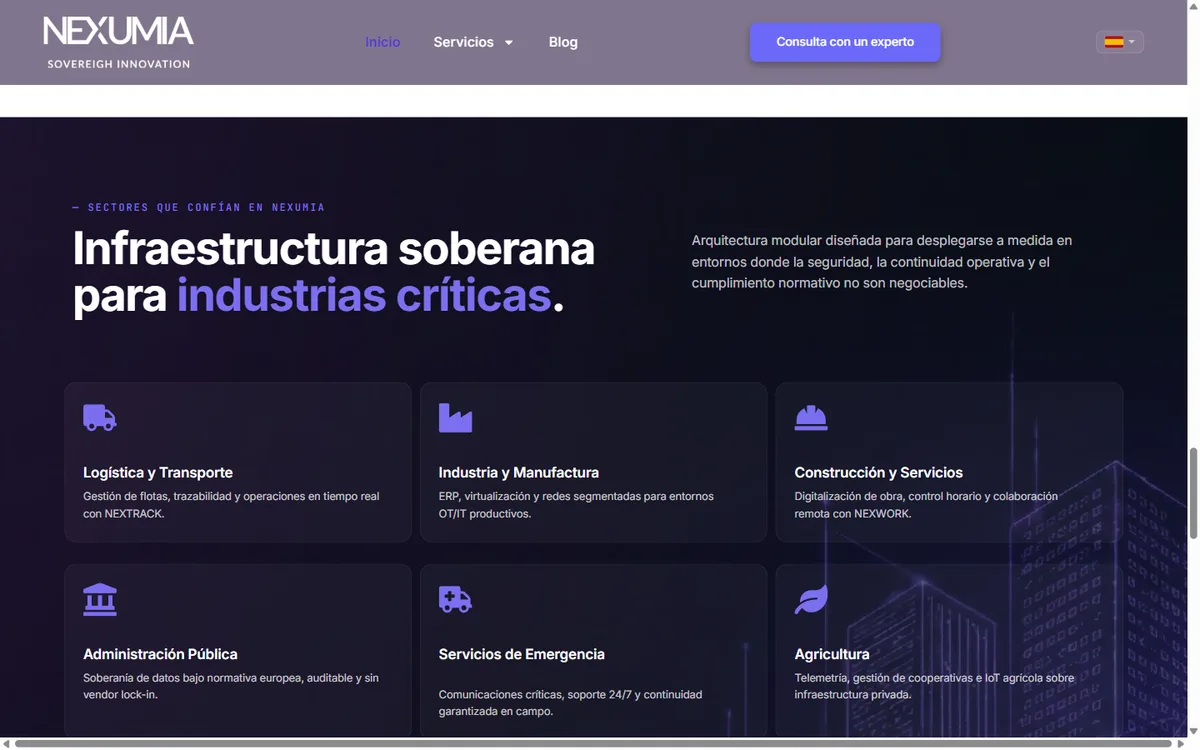
The challenge wasn’t “refreshing” a brand: it was building one from minute one and putting it in production with enough technical quality to compete against hyperscalers and global suites in sectors as demanding as industry, logistics, public administration, emergency services, and agriculture. And all of it with a multilingual scope from day one, because the target audience is European, not just Spanish.
When Nexumia approached us, there was no logo, no manifesto, no tone of voice, no website, and not a single indexable URL. Just a clear vision: technology for independence, security, and excellence. Everything else had to be built.
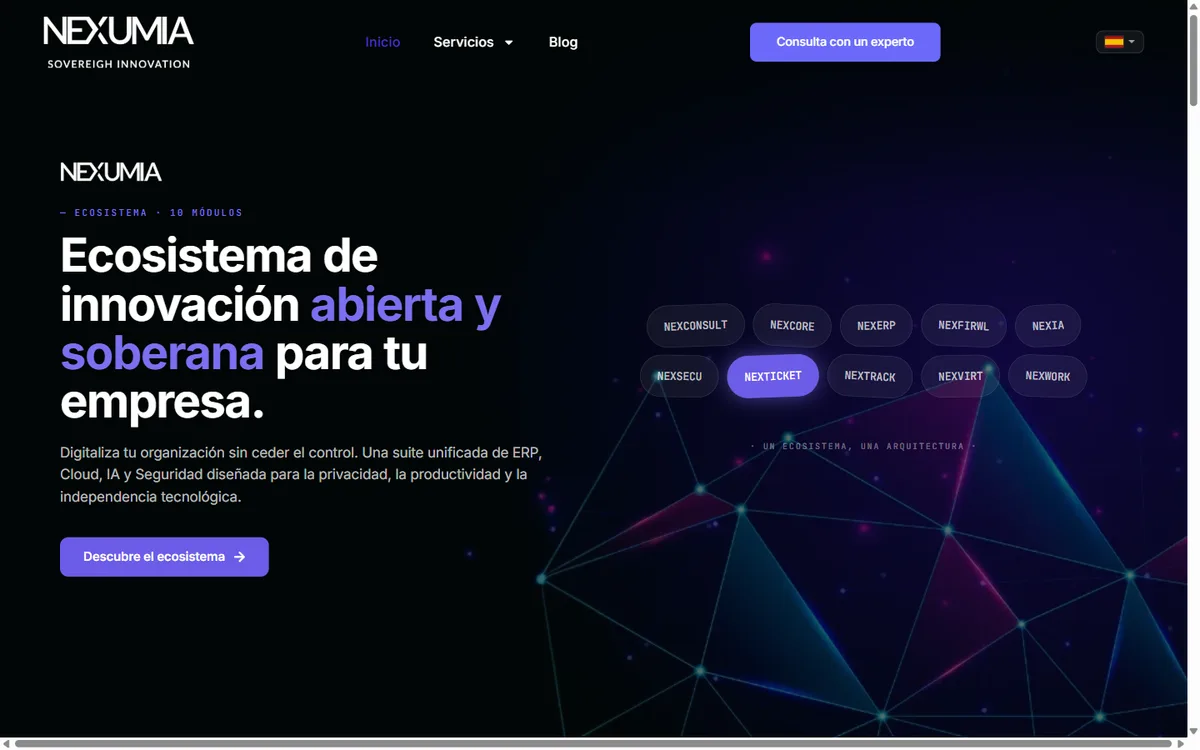
Our approach: brand, product, and SEO as a single system
Phase 1 — Brand concept and visual identity
We started with the one thing you can’t delegate: positioning. Who is Nexumia compared to a public cloud? How does it speak to an IT Manager who already has 12 tools held together with workarounds? What arguments hold up in front of a skeptical CTO?
From that foundational work we defined the central promise — “sovereign business infrastructure” — and built the full visual system on top of it: logo, color palette, typography system, an iconography system for the ten modules of the ecosystem, and consistent graphic patterns across every touchpoint. The identity conveys serious technology without falling into stock-tech clichés; European without looking institutional; ambitious without losing approachability.
Phase 2 — Verbal identity and brand manifesto
The visual brandbook was necessary, but not sufficient. For a technical brand selling to technical buyers, how it sounds matters as much as how it looks. We wrote the founding manifesto (“ecosystem of open and sovereign innovation”), the tone-and-voice system per channel, the names and descriptors for the ten product modules, and a coherent glossary of proprietary terms used consistently across web, sales materials, and support communications.
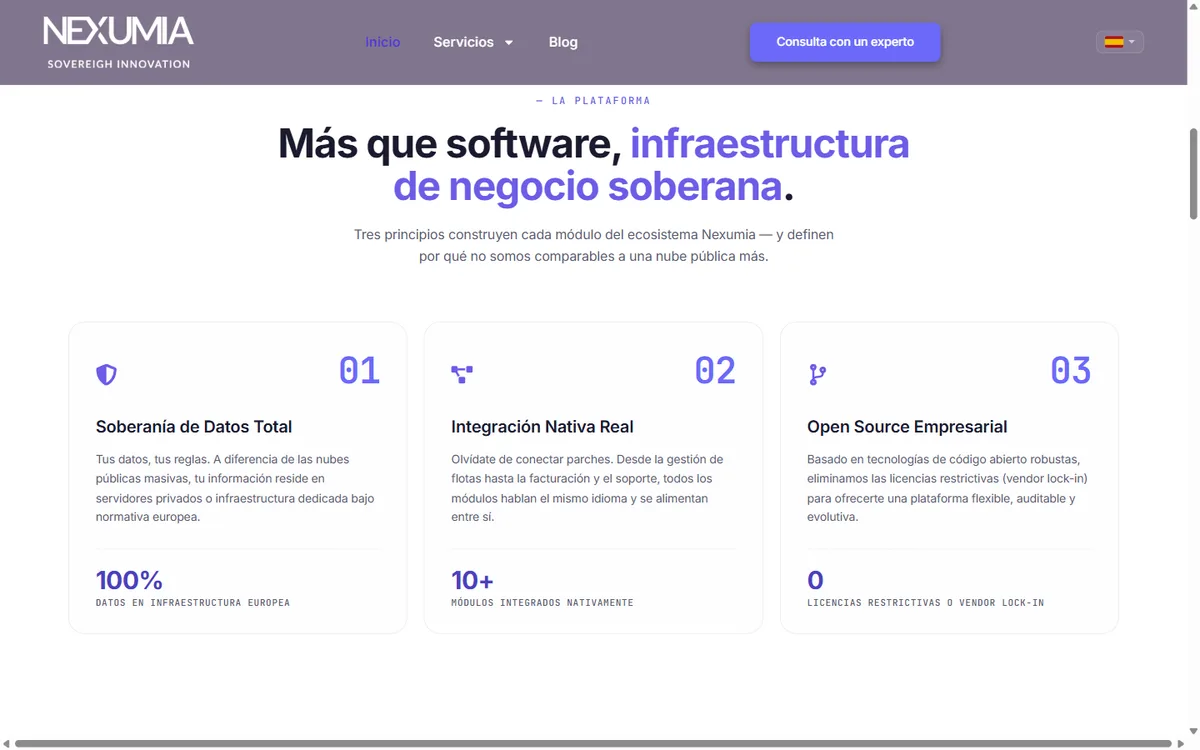
The result is a verbal universe where “sovereignty,” “native integration,” “enterprise open source,” and “vendor lock-in” aren’t loose words: they’re the three argumentative pillars that repeat — with variations — on every page, every block, and every CTA.
Phase 3 — Web development and technical architecture
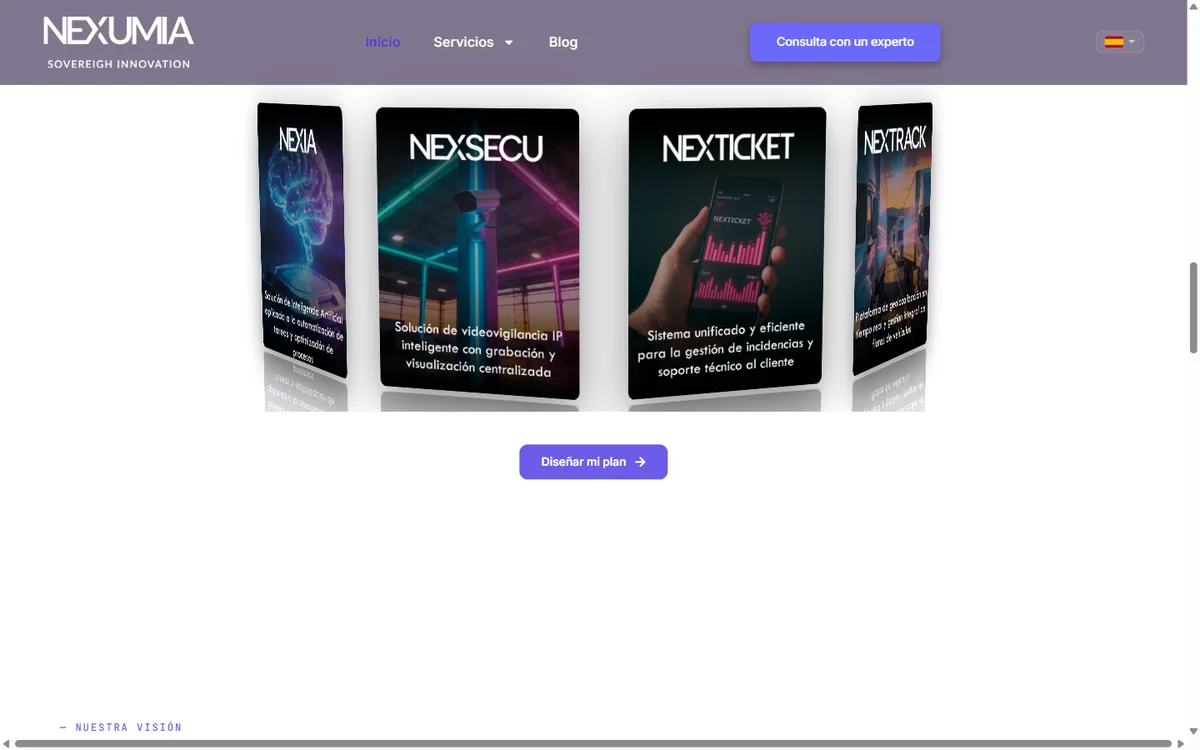
The Nexumia website was designed and built as a product in itself, not a digital brochure. Each of the ten modules has its own product page (NEXERP, NEXIA, NEXTRACK, NEXVIRT, NEXCONSULT, NEXWORK, NEXFIRWL, NEXSECU, NEXTICKET, NEXCORE), with coherent narrative blocks, specifications, sector-specific use cases, and contextual inquiry forms.
On the technical side, we prioritized the invisible foundations that hold up SEO: clean semantic structure, proper heading hierarchy, organization and product structured data, Core Web Vitals optimized from the first commit, and an internationalization system that wasn’t bolted on at the end but built into the foundations.
Phase 4 — Keyword research and SEO architecture in 4 languages
This is the difference between “shipping a nice website” and “launching a brand that shows up on Google from day one.” We ran keyword research specifically for the four target markets (Spanish, English, French, and German), recognizing that B2B searches in each country use their own vocabulary: what’s searched in Spain as “ERP open source para pymes” is searched in Germany with a completely different pattern.
The SEO architecture was built with hreflang declared correctly between the four languages, native per-locale sitemaps, consistent canonicals, and a parallel URL map across versions that prevents cross-locale cannibalization. Each product module and each vertical sector has its own optimized version in each language, not auto-translations dumped onto a page.
Phase 5 — Professional translations and the first blog articles
Translations aren’t a copy job: they’re editorial work. We adapted the commercial copy to each market, accounting for conventions, register, and units. And to activate the blog from launch — and start capturing informational traffic — we wrote the first “foundational” articles: pieces that cover the most obvious searches in the sector and give Google real content to index while the brand starts generating authority signals.
Launch results
Nexumia went live with its full 10-module ecosystem communicated coherently, 4 active languages from day one, a technical SEO architecture that passes hreflang, sitemap, and structured data checks, and a documented brand system that allows the internal team to maintain consistency without depending on us for every new piece of content.
The website is indexable, fast, and semantically correct. The ten products of the ecosystem have stable canonical URLs. The brand has its own voice in each of the four target markets. And the blog is already active with initial pieces that open the door to organic informational traffic.
Ongoing technical and SEO maintenance
After launch, Nexumia chose to continue with us on technical and SEO maintenance. This includes monitoring of technical health (Core Web Vitals, indexation errors, hreflang, schema), progressive content optimization as Search Console signals emerge, blog expansion in the four languages, and support whenever a product or sector change requires updating the website.
It’s the least visible phase and the most valuable: a brand that launches strongly but loses SEO momentum in its first months wastes the window of opportunity. Continuity is what turns a good launch into a brand that grows steadily in organic over time.