
What Exactly Differentiates SEO from SEM
Before deciding where to invest your budget, you need to clearly understand what each one is and how they differ in practice.
SEO (Search Engine Optimization) is the set of techniques that improve your website’s organic visibility in search results. You don’t pay per click. You work on the technical side, content, and links so that Google considers your site relevant and authoritative. Organic results appear below the ads in the SERPs.
SEM (Search Engine Marketing) in most contexts refers to paid search advertising, primarily Google Ads. You create campaigns, define keywords, set bids, and pay every time someone clicks on your ad. Paid results appear at the top and bottom of the SERPs labeled “Sponsored.”
The fundamental difference isn’t just “free vs paid.” It’s a difference in model. SEO is a cumulative investment: every improvement you make builds on the previous ones and the results persist over time. SEM is a recurring expense: traffic exists while you’re paying and disappears when you turn off the tap.
According to updated 2025 BrightEdge data, 53% of all web traffic comes from organic search, while paid search represents approximately 15%. The remaining 32% comes from other channels like social media, direct, and referrals.
Detailed Comparison: SEO vs SEM
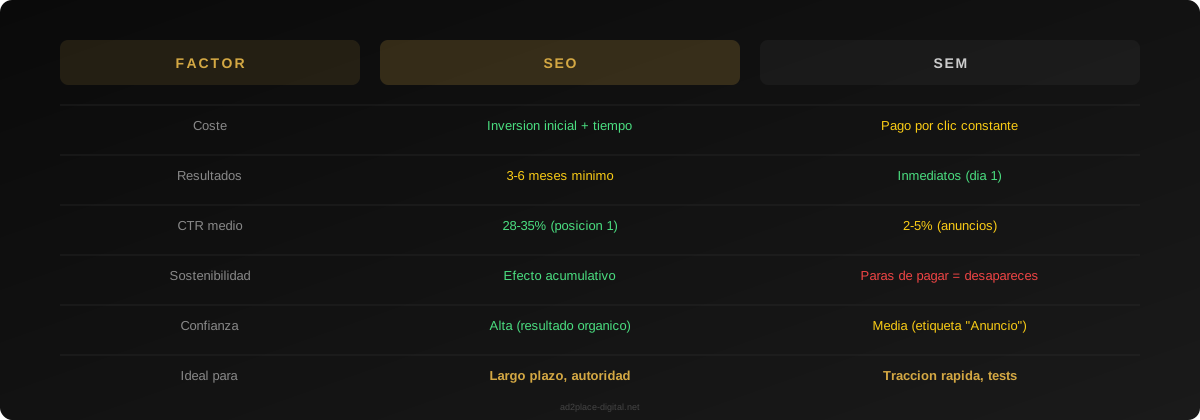
The Real Cost of Each Strategy
One of the most common misconceptions is that SEO is “free.” It’s not. It requires investment in professionals, tools, and content. But the cost structure is radically different.
SEO costs:
- Higher initial investment (audit, strategy, technical optimization).
- Relatively stable monthly costs (content creation, link building, maintenance).
- Cost per visit decreases over time as you accumulate rankings.
- For an SMB in Spain, a professional SEO strategy can range between 800 and 3,000 euros per month depending on sector competition.
SEM costs:
- Low initial investment (setting up a campaign can be done in hours).
- Variable costs depending on keyword competition. In sectors like insurance, legal, or finance, a single click can cost over 10 euros.
- Cost per visit stays constant or even increases over time due to bid inflation.
- On top of the ad budget, you need to add the cost of professional campaign management.
Practical example: Imagine your main keyword has an average CPC of 3 euros in Google Ads. If you need 1,000 visits per month, you’re spending 3,000 euros on clicks alone. With SEO, once you rank in the top 3 for that keyword, those same 1,000 visits (or more) come without any additional cost per click, month after month.
Timelines for Results
This is probably the difference that frustrates business owners the most when they choose SEO expecting immediate results.
SEM: immediate results. You can have traffic arriving at your site within hours of activating a campaign. This makes it ideal for launches, promotions, and situations where you need instant visibility.
SEO: medium to long-term results. The first significant results usually appear between 3 and 6 months. For competitive keywords, it can take 6 to 12 months to reach first-page positions. However, once you get there, the position tends to be stable.
In my experience, the break-even point where SEO starts being more cost-effective than SEM falls between 8 and 14 months, depending on the sector and competition.
Click-Through Rate (CTR) and User Trust
Not all Google results receive the same attention. The data reveals notable differences:
- The organic result in position 1 gets an average CTR of 27.6% according to 2025 Advanced Web Ranking data.
- The first paid ad gets an average CTR of 3-5% in most sectors.
- 70-80% of users ignore ads and focus on organic results, according to various eye-tracking studies.
There’s a clear trust factor at play. Users perceive organic results as more reliable and relevant than ads. This doesn’t mean ads don’t work — it simply means organic traffic tends to be higher quality with better conversion rates.
Sustainability and Cumulative Effect
SEO is like planting a garden. You invest time and effort today to harvest for months and years. Every article that ranks, every link you earn, every technical improvement you implement adds to the total result. If you stop investing in SEO, the results don’t vanish overnight — they erode gradually.
SEM is like renting a billboard. While you’re paying, your ad is there. The moment you stop paying, it disappears completely. There’s no residual effect. You’re not building a digital asset.
This difference is crucial for financial planning. A company that relies exclusively on SEM has a fixed acquisition cost that never decreases. A company that combines both channels progressively reduces its dependence on paid as SEO matures.
When to Choose SEO
SEO is the best option when:
- Your business has a long-term vision. If you plan to be in the market for years, SEO builds a sustainable traffic asset.
- Your budget is limited but consistent. It’s better to invest 1,000 euros per month in SEO for 12 months than to spend 12,000 in a single month of advertising.
- You compete in a sector where trust is key. Professional services, healthcare, education — users trust organic results more.
- You have the capacity to produce quality content. Content-driven SEO requires consistent production of valuable material for your audience.
- Your sales cycle is long. In B2B, where purchasing decisions can take weeks or months, consistently appearing in informational searches builds authority and familiarity.
When to Choose SEM
SEM is the best option when:
- You need immediate results. A product launch, a time-limited offer, or a new business opening are all scenarios where you can’t wait months.
- You want to test a market or product. Before investing in long-term SEO, you can use Google Ads to validate whether there’s demand for your product or service and which keywords convert best.
- You compete for extremely competitive keywords. In some sectors, ranking organically can take years. SEM gives you immediate presence while SEO works in the background.
- You have seasonal demand peaks. If you sell Christmas products or services tied to specific seasons, SEM lets you activate and deactivate investment based on demand.
- You need to control the exact message. With Google Ads, you decide exactly what title and description the user sees. With SEO, Google can rewrite your snippets.
The Optimal Strategy: Combine SEO and SEM
In practice, the “SEO vs SEM” dichotomy is a false dilemma for most businesses. The smartest strategy is to combine both channels in a coordinated way.
Phase 1: SEM for Initial Traction (Months 1-3)
When you launch a new digital project or enter a new market, SEM gives you immediate visibility while SEO starts building foundations. Use Google Ads data to:
- Identify which keywords have the highest purchase intent.
- Test which messages and value propositions resonate with your audience.
- Generate traffic and conversions from day one to fund the SEO investment.
Phase 2: Parallel Development (Months 3-9)
Maintain SEM campaigns for the most profitable keywords while SEO gains traction. As organic rankings improve, you can start to:
- Reduce bids on keywords where you already rank organically in the top 5.
- Redirect that budget to SEM keywords where you don’t yet have organic presence.
- Use behavioral data from ads to optimize your organic titles and meta descriptions.
Phase 3: Optimization and Efficiency (Months 9+)
In this phase, SEO is generating significant organic traffic. Your SEM strategy becomes more surgical:
- SEM only for high-conversion keywords where organic competition is fierce.
- SEM for remarketing and brand campaigns.
- SEO as the primary traffic acquisition engine.
The result: your total acquisition cost decreases because a growing share of traffic is organic, while SEM focuses where it generates the highest return.
How to Measure the ROI of Each Channel
To make informed decisions, you need to measure each channel’s return correctly:
Key SEO Metrics
- Organic traffic (sessions and users from organic search).
- Keyword rankings (weekly or monthly tracking).
- Organic conversions (leads, sales, registrations attributed to the organic channel).
- Organic cost per acquisition = Monthly SEO investment / Organic conversions.
- Organic traffic value = What it would cost in Google Ads to generate the same traffic.
Key SEM Metrics
- ROAS (Return on Ad Spend) = Revenue generated / Ad spend.
- CPA (Cost per Acquisition) = Total spend / Number of conversions.
- CTR (Click-Through Rate) of ads.
- Quality Score of main keywords.
- Impression share to evaluate lost opportunities.
The Metric That Unites Them All
The metric that truly matters is the total cost per acquisition combining both channels. If your combined CPA decreases month over month while conversion volume increases, your joint strategy is working.
Common Mistakes When Choosing Between SEO and SEM
These are the mistakes I see repeated most often among the businesses that consult with me:
Abandoning SEO because “it takes too long.” This is the most expensive mistake in the long run. Three months without results doesn’t mean it’s not working. SEO is exponential: the first months are slow, but growth accelerates over time.
Spending on SEM without an optimized landing page. There’s no point paying for traffic if your landing page doesn’t convert. Before investing in Google Ads, make sure your website is ready to turn visitors into customers.
Not sharing data between SEO and SEM teams. SEM data is gold for SEO strategy and vice versa. The keywords that convert best in Google Ads should be a priority in your organic content strategy.
Choosing one and forgetting the other. The synergy between SEO and SEM is real and measurable. Google studies show that companies appearing in both organic and paid results get 89% more clicks than when they only appear in one of the two.
Take the First Step with Your Digital Strategy
If you’re unsure where to start, or you’re investing in one of the two channels but not seeing the expected results, I can help you define a strategy tailored to your business, your budget, and your goals.
Take a look at our professional SEO services and Google Ads management, or request a free consultation so we can analyze together which combination works best for your case.